A Horse With No Name – The Simplest Song
How many of you have seen (or heard of) those “infomercials” where some guy promises to teach you how to play the guitar in what? Twenty, thirty minutes tops? The first time I saw one I had to stop and watch. Wow! I could do that? But then I thought about it. Hell, anyone could do that!
Really and truly, you can learn to play a song in less time than it takes to talk about doing it. But the problem comes with trying to figure out what you have actually learned and whether or not you will be able to apply that knowledge down the road. In my mind, simply copying something rarely teaches anyone anything. Oh, there will always be exceptions, the geniuses who will take the time to figure things out for themselves, but most of us tend toward the lazy. Better to start in learning the “whys” along with the “hows” than to try to piece it all together later.
This lesson, our very first Guitar Noise “Easy Songs for Beginners” lesson is meant to help you do both – learn a song and learn about the music that goes into it so you can actually play it and use what you learn in other songs you play. After we pick up the basics of the song, then we’ll have some fun “really playing” it by adding some strumming variations (including a very basic bass part) and in the lesson, Adding Some Personal Touches, we’ll also add some rhythm riffs (fills) and some leads (ranging from easy to intermediate). You didn’t think I was going to let you get away and not learn something, did you? It should (hopefully) be harmless…
The Absolute Basic Model
Say you’ve never played the guitar before? Well, step right up here and I’ll make you a guitar god for only $49.99 or my name ain’t…
Yeah, yeah, yeah. It gets really crazy sometimes, doesn’t it? Well, in order to proceed, I am going to (gasp) assume that you’ve held a guitar before and that you are somewhat familiar with the terminology. If not, then you need to start out with our Absolute Beginners Chords lesson. Just get to the E minor chord (it’s the first one) and you’ll be all set. No lie!
Because this lesson’s song is Horse With No Name, written by Dewey Bunnell of the group, America. The entire song consists of two chords, one of which (E minor) you know and the other we can argue about almost forever:
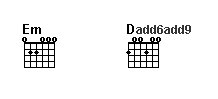
The E minor chord is, as you’ve discovered, one of the simplest to learn, but how on earth did Mr. Bunnell come up with the second chord? Well, I certainly wasn’t there when he did it, but I think it’s a pretty fair guess that it was either the result of a mistake or just exploring the fretboard. Either way, I’m sure he looked up and said to himself, “Hey, this sounds pretty cool!”
Both chords are easy enough to do. An Em requires you to use the second fret on both the fourth and fifth (D and A) strings while the Dadd6add9 simply has you move your two fingers to the next outer strings, the third and sixth (or G and low E). It’s not a hard change and it requires little thinking. Use whatever finger is on the second fret of the A string (it will probably be the index or middle) to play the second fret of the low E. Likewise, simply shift whatever finger is on the second fret of the D string to the second fret of the G. It’s kind of like doing jumping jacks with your fingers!
(And yes, we’re going to discuss this “Dadd6add9” later. If you can’t wait, just skip down to the section entitled, “What is that chord really?”)
The rhythm of the song is in 4 / 4 time (four beats per measure) and the chords change each and every measure. For starters, do a simple downstroke, either on all four beats or, if you’d like a little variation, on the first, second and fourth beats. Remember that this song is moderately paced – it’s not really fast and not really slow. When you’re first learning a song, go as slow as you have to in order to make comfortable chord changes while keeping the overall beat smooth and steady. This is where a metronome can come in very handy.
Here’s a cheat sheet of how verses and chorus should shape up:
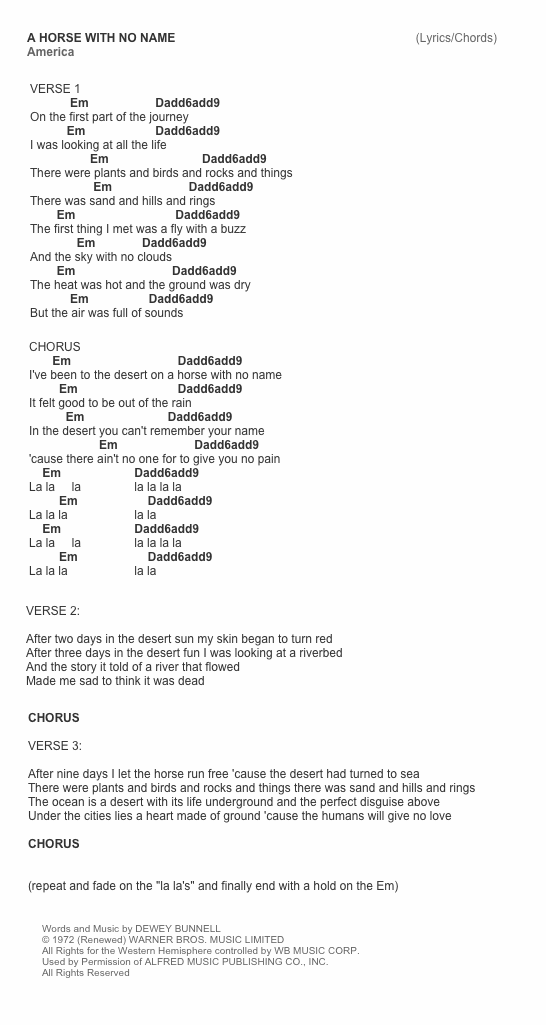
Nothing to it, right? Okay, let’s move on, then…
Tinkering
Usually the first thing a beginner needs to work on is chord recognition and formation. You need to know the chords you want to play and how to finger them on the fretboard. Your next concern will be about being able to change from one chord to the next smoothly and cleanly. With this particular song, both of those concerns become almost minimal and, because of that, you can work instead on your strumming.
You might think I’m a bit nuts about this, but I really can’t stress enough how important it is to work on your rhythm. Not only the fundamental task of keeping a steady beat, but also creating patterns that make the song better, more fun to play and interesting to hear.
But hey, it’s just hitting the strings, so how hard can it be?
Well, not hard at all if you’re aware of it from the start. This is the suggested rhythm I gave you.
An  symbol indicates an upstroke and a
  denotes a downstroke.

Now this will work but it’s hardly interesting except as a tool for helping us to keep time. A rhythm that would be closer to the original would involve working on our upstroke (coming up the strings, toward your head). It would also involve working on the beats in between the beats. The length of a note can be divided almost infinitely, but we’re going to just work with eighth notes for now. So instead of us counting, “1, 2, 3, 4,” we would want to count, “1 and 2 and 3 and 4 and…” The four beats per measure have not speeded up in the slightest. You will probably think that they have, though, if you’re not familiar with this. Don’t worry. It’s not that hard to catch on.
So here is an alternative strumming pattern, complete with the appropriate chords:
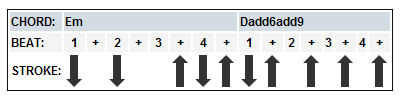
Again, start out very slowly if this is new to you. As slowly as you need to in order to count out each beat and to get each stroke in its proper place. You’ll be surprised how easily it will come to you, even if you’ve never tried an upstroke before.

Filling In The Bottom (and sides!)
Once you’re feeling up to speed we can tinker a bit more and add a bass part. Granted, it will not be the most exciting bass line in the world, but if you’re a beginner, it should impress you with how easy it is to add a lot more texture to your playing with such a simple technique.
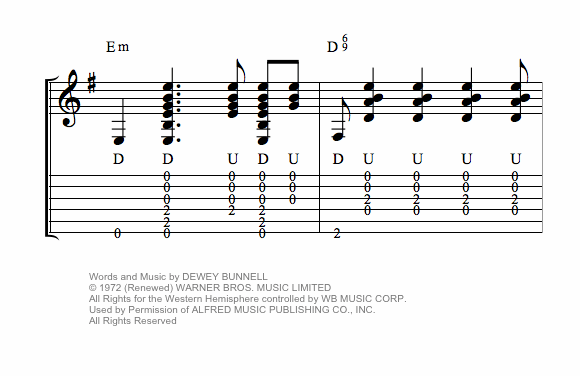
Here’s how we’ll do it. Whenever we hit the first beat of any given measure, we will strike only the sixth string (which will be the lowest tone on either chord). Just that string and nothing more. When you add in the chords (upstrokes and downstrokes), it should be something like the following example. With this Finale software notation, I indicated downstrokes with “D” and upstrokes with “U” just to make things a little easier:
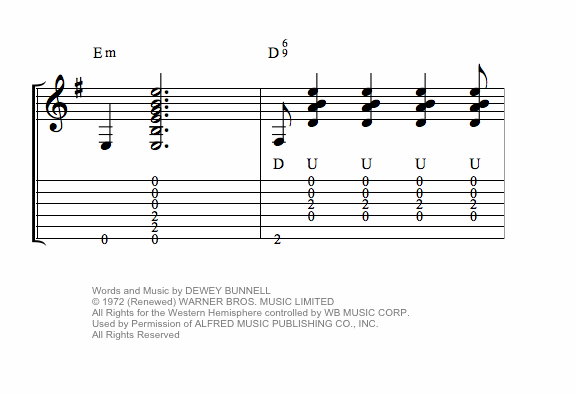
Using this pattern as a starting point, you can then start to really have fun. One thing I like to do is to play an upstroke on the second beat of the E minor as close to the bridge (as far from the neck as the strings allow) as possible and let it ring through the remaining three beats of the measure, like this:
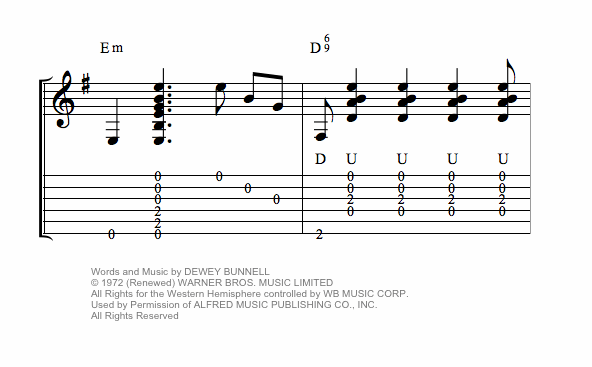
You can also pick out individual strings instead of strumming. In the following example, the three highest strings are all picked as upstrokes on the last beat and a half of the measure:
Once you have a couple of patterns that you like and can do without thinking, you’ll find yourself playing “mix and match,” throwing “E minor pattern 1” with “Dadd6add9 pattern 4” and what have you. It can become a lot of fun as well as a challenge to see what you can come up with next.
You see, even the simplest of songs can provide you with a lot of interesting opportunities if you are willing to put the time and effort into finding what can be done with it. Or you can simply learn the chords and then move on to your next song. As always, the choice is yours.
What Is That Chord Really?
Okay, let’s look at that second chord. If we examine the notes on each string, this is what we would find:

Last time out (Building Additions and Suspensions) we learned that we could, if we so desired, call this chord by a lot of different names. Who wants to start? Bm7 (add 4)? D6 (add 9)? Hey, how about E9 (sus4)? Those are all viable answers, given the notes of the chord.
We also touched on the fact that the context of the chord (how it is used in a progression) can be vital in helping to determine which chord name we will give it. An important factor in determining the context is the voicing of the chord, meaning not only which notes of a chord we use but where we play them on the guitar. Let’s take another look at both of our chords in this song:
Okay, first let’s establish the key of the song. Now we could do this the easy way: “Gee, David, it starts with an E minor chord and it ends with an E minor chord. Why don’t we just say it’s in E minor?” And I could live with this approach. But take a listen to both chords. Another reason for coming up with the same answer is simply by hearing how much more at ease the Em chord makes us feel. In contrast, the Dadd6add9 sounds unsettled, like it’s got to be going somewhere. Play the chords in reverse order and the Dadd6add9 still doesn’t sound like a resting point, like “home.” It’s just begging for a resolution.
Now, having just played the song to death, one thing that I can tell you is that I like the F# in the bass. It fits well, much better than having a D or E or even an A serving as the root. This, more than anything else, is what makes me decide that F# is going to be the root note on which to build my chord. So if I build a stack of thirds on top of my F# and fill in the notes I have from the chord (using a “-” to indicate a missing note), this is what I get:

You can see that the fifth (C#) and the ninth (G#) are not among the six notes in the chord. Instead, we get a second A. So we can call it F#m13 if we want to stay reasonably simple. Or F#m7 (no 5)(add 4)(add 6) if we want to be absolutely looney about it. But there is a lot to be said for simplicity when trying to write something out. As I mentioned earlier, people can (and do) argue about this sort of thing for ages.
But it does bring up an interesting thought – if you’ve got a chord that has seven notes what do you do? After all, you can only get six notes out of your guitar at a time, which one goes?
Traditionally, the fifth would be the note left out but, believe it or not, there are instances when the root is the “missing” note (and we’ll be examining chords like this in other Guitar Noise song lessons). But the real determining factor is what notes you are able to finger (or not finger) on your fretboard. For instance, if you strum your guitar (standard tuning) without putting any fingers on the fretboard at all you would have an A11. The notes, from low to high, would be E (fifth), A (root), D (eleventh), G (seventh), B (ninth) and E (fifth again). Here the third (C#) is the missing note. You could always add this by playing it on the 1st (or 6th) string but it sounds perfectly fine as it is. Generally a good rule of thumb with 9th, 11th, and 13th chords is to really try to include the seventh along with the root in order to give it some sense of identity.
Is any of this really that important? Like any knowledge, it all depends on what you want to do with it, and that’s what next week’s topic is all about. You’ll see that by giving our second chord an identity of Dadd6add9, we are helping to determine the modal centers of our harmonies. This is ultimately where our fills and leads will come from. And no, it’s nowhere near as complicated as it sounds!
As always, please feel free to write in with any questions, comments, concerns or topics you’d like to see covered in future columns. You can either drop off a note at the Guitar Forums or email me directly at [email protected].
Until next week…
Peace
Nate
November 13th, 2016 @ 4:51 pm
Been looking at a few places online to help me brother learn guitar. anyone have a good experience with jamplay?
Tyler
October 27th, 2016 @ 7:56 pm
I just started taking guitar lessons this week, and my instructor talked with me about how so many songs just use a few chords and that with 8 or 10 chords, I would be able to play many popular music songs. What brought me to your site was that he demonstrated “A horse with no name” to show how with just 2 chords you can play a great song. This is a great resource – I really appreciate the audio clips that demonstrate how it is supposed to sound at each element. Thanks!
Philip
February 23rd, 2016 @ 2:02 pm
Wow, this was so helpful in so many ways! This lesson really get’s you going and is fun, whereas other ‘first lessons’ are simply dull and seem to lead nowhere. It was also really great to learn just how much you can do with only two chords. Great stuff overall! Many thanks!
Ron
October 25th, 2015 @ 9:09 pm
Just started lessons at 66 about six weeks ago. Always liked this song. When I realized it was simple I started working on it.. Two chords, easy, but the strumming is making me work! And I’m having lots of trouble with the muting on the upstroke. But thank you for the clear and visual lesson.. I’m gonna keep coming back?
John
September 24th, 2015 @ 1:52 pm
Nice post! I have been playing for some years now and I plan to start teaching and to make use of a blog and other media at some point. Basically research to see what others are doing brought me to your site. Its really interesting to me, and one of the many things I love about playing guitar and music in general is that you never stop learning. Even a basic simple song like this has stuff to offer for players of all levels and you do an excellent job of bringing that out while still keeping it simple enough for the absolute beginner. I am about to start teaching my brother to play and songs like this are perfect because he will recognize it and it is easy. I look forward to digging through the rest of this site. Thank you for sharing your knowledge!
Kim
August 1st, 2015 @ 6:34 am
Wow! What a great tutorial! I used to play Horse With No Name in the 70’s as a kid, so finding your tutorial is a real treat! Love the strumming rhythm! Since my daughter is in the hospital, and the music therapist dropped off a guitar for her to learn to play, I too picked up the guitar again and searched for easy songs to play. So glad I found your site! Really clear tutorials. So fun to be able to play this again way better than I did back then.
Harold
June 10th, 2015 @ 9:57 am
I’ve been a drummer for 45 years in the same band for 25 years but I play guitar around the house. I have never played guitar in a band. I was wanting to learn more opening chords like the 9th 7th aug, sus, & so on, I found this site and realized I already knew most of the chords and have been playing them for years just didn’t know their names. I had a friend ask me about putting a duo together and I didn’t want to look completely stupid. I want to thank you for the information, now I can start this new adventure.
Andrea
May 7th, 2015 @ 1:27 pm
WOW – great teaching!!!! I have been trying for ever to get that beat going….
Nate
April 30th, 2015 @ 4:09 pm
Awesome lesson! I have to second what Sherri says, the lesson really did take the “i can’t do this” out of learning (well actually I usually use a few curse words instead!)
Sherri S
April 8th, 2015 @ 10:57 am
Thank you David. Awesome site and took the “I can’t do this” right out of me.
Ricardo Garcia
February 11th, 2015 @ 6:19 am
Hi, this is a great tutorial. I’m learning and playing this on a electric guitar, this is ok right? I always tend to think that playing acoustics songs or chords on a electric guitar isn’t the best way because I may not be getting the best sound possible.
Tasha
November 7th, 2014 @ 7:13 am
This is the best lesson ever!! Played this song as a beginner years ago & basically just strummed the chords once per line where it says…. had no clue!!! May encourage me to pick it up again.. :)
Daniel Minchew
July 10th, 2014 @ 9:11 am
David, from the bottom of my heart THANK YOU i have owned a guitar for over 35 years,im 52 now and never could understand music,beats, and patterns till now.Blessings and thanks!
Solphivyaé Rose Thunderword. - Cohen
May 13th, 2014 @ 11:36 am
Hello Mr. Hodge,
I am a beginning guitarist. I recently purchased a guitar for my 49th birthday.
After scouring the Internet for free lessons and after trying out many different sites I like yours the best. Why? Because the instructions here come in small chunks and the directions and their related images are clear and concise. And last but not least, you make the lessons fun. It’s not a collection a boring repetitive finger exercises I’m actually learning how to play song. WHILE, i’m learning chords etc.
Thank you for this site and being a really cool teacher.
Because I live on a fixed income your site is a blessing to me.
Debe
January 21st, 2014 @ 7:10 pm
Hi Mr. David! I have played the drums for about 17 yrs and decided to try the guitar. I have been poking at it for about 2 yrs and decided to get series about it. I know all the basic cords (except the F & B) which I cannot seem to master. My problem is, because I am a drummer, I seem to follow the BEAT of the song with my strumming! So needless to say it is a hard transition for me. I was looking at your lesson on the song Horse with No Name and was wondering if you have video to go along with your lessons? I would also like to know what you are charging to get these lessons and how often you give them? Thank you for you the lesson you gave and I will be giving it a try till I get it right!
Your musical new guitar friend,
Debe
Juan David
January 14th, 2014 @ 9:20 pm
Thanks a lot, this is a great lesson!
Thanks!
Claudine
October 7th, 2013 @ 9:27 am
(Sorry for my bad english)
Hi,
i just started Guitar last week ( I m 48 years old)
thank you for your job, your explanations are so clear that it’s a very big help for me to understand how the way to move my hand, to find the rythm.
Amitiés.
bob
June 28th, 2013 @ 10:50 am
Hi David, this was my first song i learned about a year ago, strange how i keep going back to it, anyway, thought i would learn some theory and boy what a pickle I’ve got in. pentantics, root notes and stuff, does an old codger have to learn theory, don’t want to set the world on fire, just bumble along trying to remember my youth!!
Doing a great job, by the way, please don’t stop now!
David Hodge
May 27th, 2013 @ 5:49 pm
Hi Jacob
Thanks for writing. Without being able to see you play, it would be helpful to know more about what, exactly, the trouble with the upstroke is. For most beginners the key to playing upstrokes is to realize two things – first, it’s a matter of strumming with the wrist and keeping the wrist going in a perpetual motion. Second, it’s only necessary to strike two or three strings on the upstroke. Hitting all six strings tends to create a muddy sound. Think of the upstroke as a short motion with the purpose of positioning yourself for the next downstroke.
I hope this helps get you going. Please feel free to write more about your difficulty if this advice isn’t helpful.
Looking forward to hearing from you again.
Peace
Jacob
May 27th, 2013 @ 10:22 am
Hello, I’m just starting out on guitar, and I’m very lucky to have found your site. Although, I seem to have a lot of trouble with an upstroke. Not the rhythm, just playing an upstroke. Help.
Les
January 8th, 2013 @ 5:42 am
Thank you very much for this website, I have found that after several failed attempts to learn guitar I now have something I can both follow and relate to. Horse with no name is an inspired choice as a beginners tune and at 50 years old to at last be able to play a song and have it sound correct is brilliant.
Looking forward to trying out the rest of the tunes.
Tony Miranda
October 30th, 2012 @ 9:29 am
I enjoyed your in-depth tutorial concerning this song, which by the way, is one of my favorites and easiest to play. However on the second part of the song (chorus) I play a Em9 and a Dmaj9 which I learned from a songbook for easy guitar playing. those are not hard to play and makes the song less monotonous.
David Hodge
October 30th, 2012 @ 12:06 pm
Hi Tony
And thank you for your kind words concerning our “Horse With No Name” tutorial. Glad you liked it.
You certainly can play the chords you mention during the chorus, or even during part of the verses. D6 (XX0202) also works well. And making the song less monotonous is a good thing. On the original recording there are several acoustic guitar parts (at least one done with a twelve-string guitar) playing different chords and voicings so changing around when we’re playing a single-guitar arrangement is definitely a smart way to go.
Looking forward to chatting with you again.
Peace
deercoffee
September 6th, 2012 @ 7:45 am
Thank you for this! I just started trying to play the guitar last week and was so glad to stumble upon this well understandable lesson. It’s so much fun to alter this song step by step.
Jazzsaxman
July 1st, 2012 @ 2:52 pm
Great lessons. I play sax and decided to take up guitar to help with my understanding of chord progression. With the silent guitar and your tutorials I can practise late. Thanks David look forward to the next one.
TOM JUNG
June 27th, 2012 @ 4:27 pm
David, my friend, your lessons great so clear and concise. The lessons and blog keep my fired up for guitar learning and enjoyment. Thanks so much. Tom
David Hodge
June 27th, 2012 @ 8:08 pm
You’re welcome, Tom. Thanks for your kind words.
Looking forward to chatting with you again.
Peace
bob
June 5th, 2012 @ 11:42 am
cannot beleive it, just got a guitar, tuned it, sort of, and on my first day have played a tune, amazing, even my wife said she recognised it, what a great feeling for a pensioner. congratulations on your very clear and well constructed lessons
David Hodge
June 6th, 2012 @ 6:58 am
Hi
Thanks for writing (and for your kind words) and congratulations! Welcome to the wonder of making music!
The cool thing is that this is just the starting place. You’ve got a whole world of music waiting for you to play! Enjoy!
And always feel free to post here (or email me directly) with any questions you may have. Looking forward to hearing how things are going with you.
Peace
Joey Blue
May 11th, 2012 @ 9:09 pm
Of course “A Horse With No Name” is easy. It only has 2 chords. It is musically monotonous.
David Hodge
May 12th, 2012 @ 4:39 pm
Hi Joey
Thanks for writing and I agree with your assessment that “Horse With No Name” is easy because it just has two chords. For someone who has just picked up a guitar and possibly never played a single chord before, this is the sort of song that is encouraging because it’s reasonably easy to play. Usually a beginner is so engrossed with making the chord changes, not to mention doing so in steady rhythm, that there’s little opportunity (at least at first) to become bored.
Being “musically monotonous,” though, is an entirely differrent matter. Any song can become boring after a while. A good musician can make any song, even one with one, two or three chords, sound interesting. That’s one of the reasons behind the “follow up” article to this song lesson (https://www.guitarnoise.com/lesson/horse-with-no-name-2/) – to give a beginner some basic ideas on which to start creating his or her own arrangement to the song. And to plant the seeds of musical exploration and adventure.
There are, as I’m sure you’re well aware, guitarists of a seemingly infinite degrees of playing levels and expertise. This particular song lesson is certainly not meant for someone who’s been playing a while! However, anyone who has been playing a while and who is into creating music can, more likely than not, come up with even more ways to keep a simple song like this from becoming musically monotonous. That’s part of the fun of playing.
Looking forward to chatting with you again.
Peace
Carlos
March 13th, 2012 @ 5:44 pm
Fixed and working! thanks a lot for the fast response.
Keep writing articles please, i love the webpage, I’m learning superfast!
Cheers!
Carlos
Carlos
March 11th, 2012 @ 10:20 am
Hey
The “HORSE3.mp3” is missing, you loaded No. 4 twice :(
Can you please load the missing one :) i love the song.
Thanks for the articles!!!!!
David Hodge
March 11th, 2012 @ 10:58 am
Hi Carlos
Sorry about that! I’ve think I’ve managed to fix it (and considering that Paul usually does this sort of thing since my computer skills are practically non-existent, this is a big step!), so try it again and see if it works.
Peace
David
Howard
February 29th, 2012 @ 1:05 pm
Thanks Dave, i’m new to the guitar, just bought my first one last week, i have followed your tutorial closely and found it good, my problem seems to be strumming, the pattern doesn’t quite fit, what am i doing wrong.
cheers
How
David Hodge
February 29th, 2012 @ 3:12 pm
Hi Howard
Thanks for writing and welcome to Guitar Noise!
When you say “the pattern doesn’t quite fit” I have to ask “Fit what, exactly?” If you’re trying to make yourself sound exactly like the guitar on the original recording of “Horse With no Name,” you can’t – because there is more than a single guitar strumming chords in that recording of the song. One of the biggest traps that beginning guitarists fall into nowadays is the idea of there being something called a “strumming pattern.” To play a song correctly, it’s about keeping the rhythm right, not about following the specific strumming done on the original recording. We’ve a good article here at Guitar Noise called “The Pattern Trap” (https://www.guitarnoise.com/lesson/the-pattern-trap/) that might be of help to you.
Without being able to hear you strum in order to make sure you’re keeping time correctly, it’s close to impossible to say that you’re doing anything wrong. So if you can let me know why you think you’re off (and you can post again here or email me directly at [email protected]) I’ll do my best to help.
Looking forward to chatting with you again.
Peace
Cheryl Nolan
February 14th, 2012 @ 12:31 pm
I just want to thank Guitar Noise for helping me to learn to play guitar. After reviewing many websites that offer free lessons on line; Guitar Noise is simply the best. Lessons are clear, concise and cover just about any topic you can think of. Thanks Guitar Noise; I am really enjoying the process of learning to play the guitar.
David Hodge
February 17th, 2012 @ 8:49 am
Hello Cheryl
And thank you for your kind words! And while we here at Guitar Noise take a lot of pride in our lessons, we also think that one of our biggest strengths is our community. On our Forum pages you will get a lot of great advice from guitarists of all levels of experience, from fellow beginners to those who’ve been playing for more than fifty years. I’m not sure there’s a friendlier place out there on the Internet.
And you should always feel free to post any questions you may have here or email me directly at [email protected].
Looking forward to hearing how things are progressing with you.
Peace
enrique
March 26th, 2016 @ 8:58 pm
The original tuning for this song is D E D G B D.