
Margaritaville – Jimmy Buffett

One of the easiest ways to quickly improve your guitar playing is to start thinking of your instrument as being more than just a single guitar. Once you’ve gotten the strumming part down and have a fairly good grasp (no pun intended) of the various chords, you can start to put together actual arrangements of songs. Even a relative beginner can work out simple arrangements using a little thought and a little theory to dramatically improve his or her playing.
Today we’re going to learn Margaritaville by Jimmy Buffet. In and of itself, this will not take very long. We will only need three chords. Okay, four, but one – A7 – is just a simple variation of another:
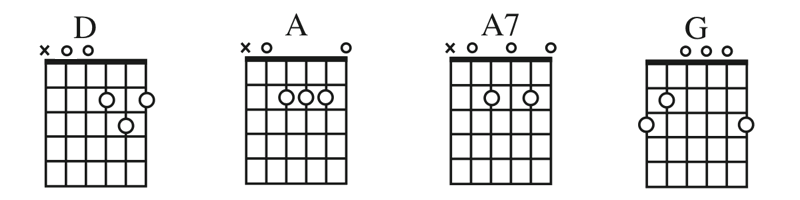
And then, of course, we will need to know when to change the chords. Here is how the first verse and chorus goes:
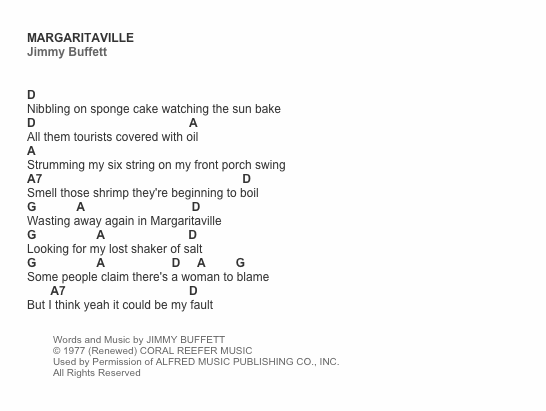
Okay we’ve got the chords and the lyrics, how about an easy rhythm pattern? Since this is a fairly happy-go-lucky, tropical song, at a relatively moderate tempo, a nice, light, airy strumming pattern seems to be just the thing to play. Let’s try accenting the first and third beats while playing eighth notes in a simple down-and-up stroke on the second and fourth beats, like this:
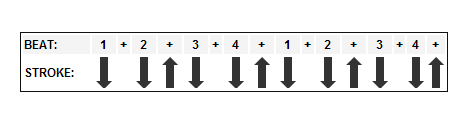
If you use this strumming template through the song, and if you can make the chord changes in a timely manner, then you’ve already got this song down cold. Ah, but that would not be much of a lesson then, would it?
As mentioned at the start of this lesson, if you begin to think of your guitar as “more than just a single guitar,” then you can begin to reach a new and exciting level of playing. As beginners, guitarists tend to worry about one aspect of playing at a time and that is probably a good thing. But there comes a point where you have to branch out a bit and today we’re going to take a step in that direction.
The easiest thing to do, as a beginner, is to learn to develop a bassline as part of a strumming pattern. We did this in our very first Easy Songs For Beginners piece, Horse With No Name. Take a second and look that over if you’ve forgotten.
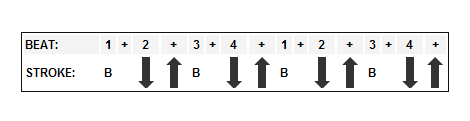
Adding a bassline (more accurately in the case, a single bass note on specific beats) to our strumming pattern. The most common thing to do is to play the bass note on the first beat of every measure. Since we have a lot of space, though, let’s use it on the third beat as well. Here, then, is our “bass enhanced” pattern. I have replaced the downstrokes on the first and third beats with the letter “B” which means that we’ll play a bass note instead of a full chord on the downstroke. Our bass note in this instance is simply the root note of what- ever chord we are playing. For a D chord, it will be the open D string. On the A (or A7) chord, the open A string. The G note on the third fret of our low E string will serve as bass note for the G chord. Go on and give them a try:
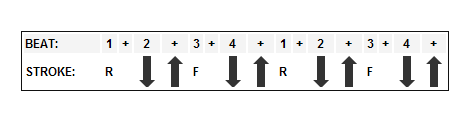
Once you’ve got this down, the next step is to give your bass line a bit more spice. The simplest (and yet very cool sounding) way for a guitarist to do this is to develop what is called an “alternating bassline.” This means exactly what you’d think it might. You alternate the root note with a different note in the bass. Traditionally, the fifth is the note that alternates with the root. In the strumming pattern that we’re using on Margaritaville, it is easy to play the root on the first beat (followed by the chord on the second) and the fifth on the third beat (again followed by the chord on the fourth). Here’s what it would look like (R = “root” and F= “fifth”):
Okay, what do “root” and “fifth” translate to in terms of specific notes? To answer that, we think about how chords are created (and you can easily do that in our lesson The Power of Three) and then take a look at each of our chords, paying particular attention to their roots and fifths:
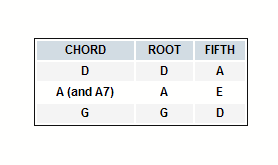

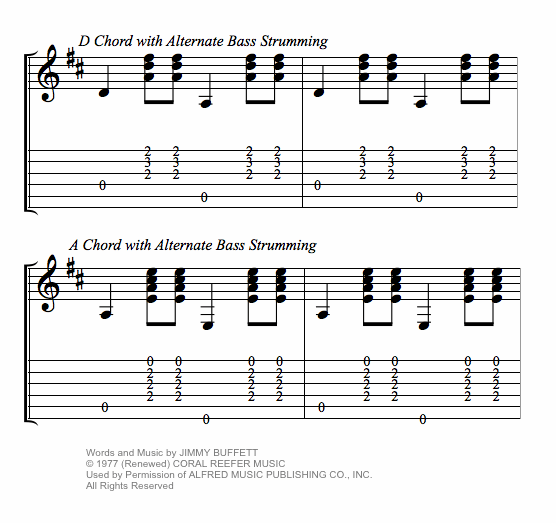
Playing the D and A chords should be fairly easy, since both the roots and fifths are simply open strings. Even better, the fifth is the open string below the root (you’d almost think that someone planned the guitar that way, wouldn’t you?). The simplest way to go about playing these two chords would be to first hit the root note (the open D string for the D chord and the open A string for the A chord) on the first beat, then striking the rest of the strings of the chord in an down-and-up pair of eighth notes on the second beat. Then you’d pick the fifth of the chord (the open A string for the D chord and the open low E string for the A chord) on the third beat and finally repeat the down-and-up eighth notes of the chord on the fourth beat. It will look and sound like this:
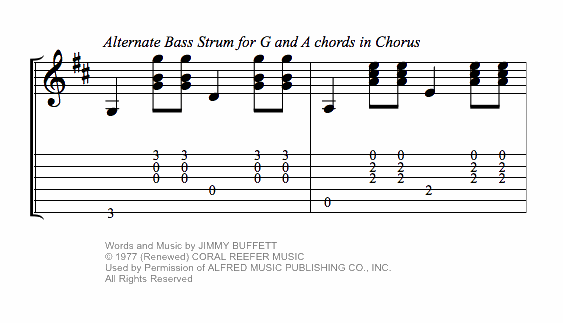
The G chord is also easy, although it might seem a bit confusing at first. Whenever possible, it’s a good idea for the root note to be the lowest tone (of that particular chord) that you can attain on your guitar. If your fifth happens to be lower than that, as it was on both the D and A, then great. On the G, our root is the third fret on the low E string, no problem. But our nearest fifth, D, is above the root. Unless you decide to play this song in “Drop D” tuning (and that’s a whole other lesson!) you’re going to use the open D string for the fifth when you play this alternating bass strum.
But let’s consider something else – since the G only appears in the chorus and it is always followed by the A, why not play those A chords of the chorus in the same style as you’re playing the G, that is, with the higher fifth. It should make for an interesting contrast to the strumming of the verses, not to mention keep you from being bored from playing the same strum template over and over. Here’s our TAB for the G as well as the “chorus” A chords. Keep in mind that in the chorus both the G and A chords each receive one measure (four beats):
Since you’re already tinkering around with arranging the chorus, here are two more suggestions: First off, on the penultimate line in the chorus (“…some people claim…”) simply strum each of the last three chords, just as they do on the recording. That’s a two-beat hold on the D and A chords followed by a four-beat hold on the G. Now you don’t have to worry about a bassline at all in this section!
And since you have a spot where you’re arrangement is “bassline free,” you can make up for that lack of bass by using a short “walking” bassline between the D and G chords in the chorus, like this:
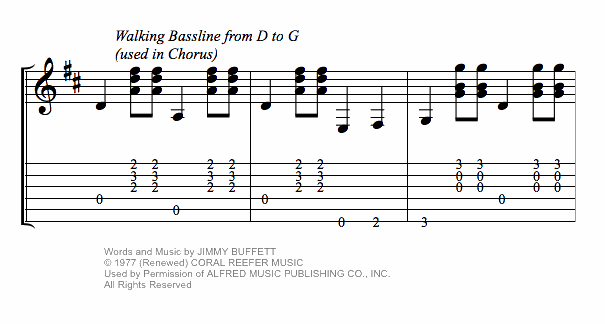
This also offers a bit of variety and keeps the bass part from being too static. The trick of any walking bassline (and you can read up on simple walking basslines in our four Connecting the Dots lessons) is to make certain that you arrive at the proper note at the proper time. No problem here. Since the G is on the first beat, simply play F# (second fret on the low E) the previous (fourth) beat and play the open E string the beat before that. Piece of cake.
So you see, with a minimum of effort, we’ve taken a song that, in all likelihood, we would have simply strummed and given it some added depth and color.
Okay, this covers about everything. Oh, wait a minute – as a bonus let’s add the “signature riff” that is played as the intro. You can also use this to end the song if you want to sound like the recording. Just tack it on to the end off the last chorus. This is a very simple thing to do, using the ideas from the Moving On Up lesson on movable chord shapes up and down the neck.
Also, let’s add a walking bass line using notes on the A string to connect between the signature riff to the start of the verse and we should be ready to do the whole song:

As always, please feel free to write in with any questions, comments, concerns or topics you’d like to see covered in future columns. You can either drop off a note at the Guitar Forums or email me directly at [email protected].
Until our next lesson…
Peace
alami
November 8th, 2015 @ 5:33 am
This was really helpful and i have always really liked Jimmy Buffett! Thanks for your help ok
Jim
January 22nd, 2015 @ 8:27 am
Hi David,
Been messing around with the guitar off and on for years. (Will be 74 on 1/30) Never stayed with it long enough to get beyond basic chords, but this is fun, and so far I’ve been able to follow along and understand much better then i have in the past.
Just want to say Thanks. How neat if I could impress the grandkids by playing Margaritaville!
Keep up the good work.
Jim
Lorraine
October 10th, 2014 @ 3:16 pm
Hi there! I have been playing basic acoustic for years. I have recently began giving lessons to kids. I realized that I never went a whole lot beyond what I already knew. I decided to work on/learn baseline walking. I always played Margaritaville, but no walking. I do not read music, so I had a bit of a problem following the walk from D to G, as well as the intro. Do you make any videos? Also, can you please tell me the notes in the walk from D to G in this song. Thanks again. I think you can teach an old dog new tricks!
eric snyder
January 4th, 2014 @ 10:50 pm
Thank you, I am a student at Gavilan College In Gilroy CA. The knowledge you shared helped me a lot in my music ensamble class.
David Hodge
January 5th, 2014 @ 9:38 am
Thank you for your kind words, Eric. We’re glad to be of help. Hope that 2014 turns out to be a great year for you, your friends and your family. Best wishes to you with your college studies and we look forward to chatting with you again.
Peace
Kathleen
December 1st, 2012 @ 2:07 am
I don’t play guitar or even have one for that matter! But this Jimmy Buffet song looks like so much fun I want to get started. You are right on that a beginner will impress folks with this song. What a great teacher you must be….thanks for all you offer.
James
October 31st, 2012 @ 8:03 am
Hi David.
I have been searching for an easy to use and understand online guitar tuition for what seems like ages now, and finally in this I believe that i have found it.
Now looking forward with renewed confidence to learning to play as a complete novice
Many Thanks
Sydney Owens
August 22nd, 2012 @ 6:12 pm
This was really helpful and i have always really liked Jimmy Buffett! Thanks for your help :)
Joseph Facey
May 12th, 2012 @ 6:00 pm
Hi David,
After looking at your web site i carry a whole lot more confident in learning guitar. I just retired from work and started looking at things to keep me busy, walla! Guitar. I am enlightened that most of the songs I like only have 3-4 cords. Motivation to keep practising. Thanks for that.
All the best,
Joseph
David Hodge
May 13th, 2012 @ 6:47 am
Hi Joseph
And thank you for writing. You’ll be amazed at how many songs (not to mention how many songs you probably know) that have only three or four chords. You’ll hopefully never lack for motivation when it comes to playing!
Looking forward to chatting with you again.
Peace