
You Say You Want a Resolution…
COMING ATTRACTIONS ALERT (part 2): (and I bet you thought I was kidding when I said we’d pick up “right where we left off…”) Due to an overwhelming demand, Paul and I are going to be revamping a few things in order to bring you a new and (hopefully) vastly improved Scales and Modes page. With a little luck, and a lot of work, it will up sometime later this summer. If you have any input for this project, please email me directly at [email protected] and I will be more than happy to take your advice into consideration. This page is going to be for you, after all.
Okay, on with the show. First, how about that disclaimer (you know, the one I remembered to mention but not to write last time!)?
These files are the author’s own work and represents his interpretation of the song. It is intended solely for private study, scholarship or research.
Much better.
Last time out we started with tonality and the use of the V to I cadence. Today we’re going to delve a little deeper into musical phrases and two other common types of cadences. To provide a little bit of definition, let’s turn to Walter Piston’s text, Harmony
A musical phrase can best be defined by analogy: the phrase in music is comparable to the line in rhymed verse. The phrase shows a certain regularity in its number of measures, which is usually four to eight. Most important, the phrase is perceived as a unit of musical thought like a sentence or clause, and it generally implies that another phrase is to follow unless it shows a certain amount of finality. The phrase is what measures the beginning and ending of a melodic unit, as well as the point of departure for the next.
The end of the phrase is called the cadence. The origin of this word (from the Latin cadere, “to fall”) suggests its significance, as a kind of metric punctuation mark, not a pause but something more like a breath. Like the final syllable of a line of metric verse, the cadence is metric in function; at the same time, to continue the analogy, the cadence is always marked by a certain conventional harmonic formula, just as metric verse is ordinarily marked by rhyme.
If you examine any song that you happen to think of, you will find this to almost always be the case. Yes, there will always be exceptions, but in the study of music theory, it is the norm, which most concerns us. Why? Think about it. Songs become popular and stay popular because of their familiarity. They are our dear friends. We know them well. And the two easiest things to remember about them (musically now, not lyrically) are their melodies (which we’ll look at next week) and their structure. The structure is based on phrases, which in turn are built with cadences.
For those of you who are into definitions, going from V to I is called the authentic cadence. Some music theorists expand the authentic cadence to include the II or the IV which often proceed the V.
A half cadence is any cadence that ends on the V. Remember what I told you last time about the use of the V chord as a way to end a line or phrase? That jives perfectly with Piston’s “generally implies that another phrase is to follow unless it shows a certain amount of finality.” Nothing says, “there’s more coming” better than ending a line with a V chord. Traditionally, a half cadence is used as the first of a pair of phrases, the second of which ending in an authentic cadence. This is the easiest example I can think of:
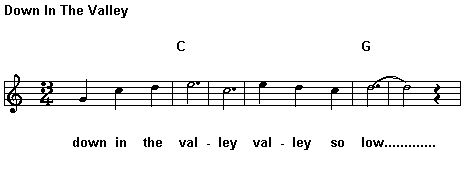
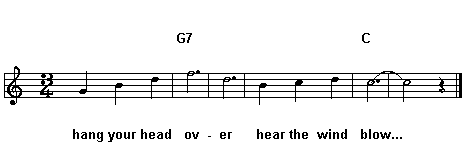
When I first arrived in college, one of my new roommates and I played every single song we could think of with that only consisted of a C to G and then G back to C phrasing. It took us the better part of an hour.
All Four One…
Obviously, not each and every song ends each phrase with the V or a I. Things would get incredibly boring that way. Luckily, there are other cadences. IV to I (called a plagal cadence) is probably the second most used cadence around. Look at structure of this traditional song, I Wish I Was In London, made up solely of a half cadence followed by a plagal cadence (in G major in this version):
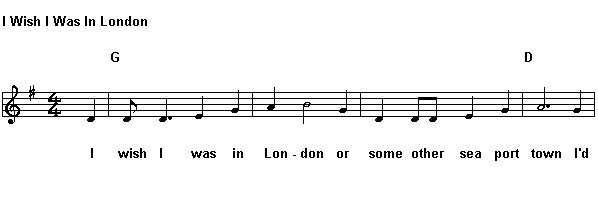
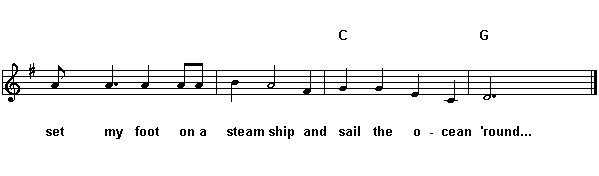
Those of you who are familiar with a lot of folk music or traditional music can without a doubt recite a nearly endless list of song titles using this chord structure. Which brings us to probably the most important of today’s discussion. Some of you have clued in pretty quickly that knowing traditional cadences can really help you when you’re trying to figure out a song. And those of you who are into songwriting can also see the importance of knowing this kind of theory. But one of the best uses for this material is also perhaps the most underused: your knowledge of musical phrases and traditional cadences is probably the best tool at your disposal to help you memorize songs. Think about it (maybe that’s today’s catch phrase). If you’re trying to memorize a song like Jimmy Buffet’s Magaritaville, and you know that it’s in the key of D major, then you also know that the most likely chord changes you are going to encounter will involve the I, IV and V. That means D, G and A. And sure enough, here’s the first verse and chorus:
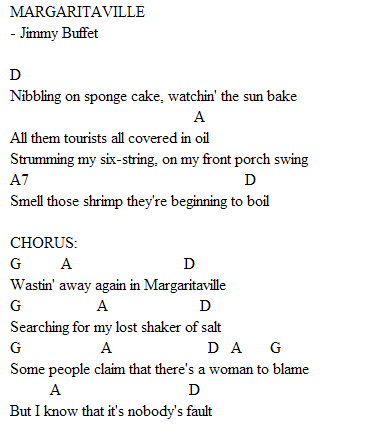
“Hey,” you’re probably saying (I hope!), “the verses are the same as down in the valley – I to V and back to I.” If you’re not saying that, please take another look. Yes, the time signature and the key are different but the phrase is the same. As you’re undoubtedly tired of hearing (from both A-J and myself), but there are only so many chord changes available to you. This is why, as a rule, people who know even the slightest bit of theory are fairly good at memorizing songs. They tend to think in terms of Roman numerals instead of chords and there are even fewer of those to pick from!
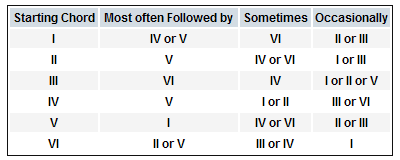
And speaking of Roman numerals, do you remember those chord progression charts I did up for you back in February (A Before E (Except After C)? Didn’t think so. But they’re a good thing to have around while we’re discussing musical phrases, if for no other reason than to see how so many songs follow these patterns. Here’s what I’m talking about:
Another use of the plagal cadence (which is not as prevalent these days as it used to be) is the transition from IV (minor) to I. In the key of A major, this would be a cadence from Dm to A. I think the reason I find this particular cadence enchanting is that, much like V7 to I, it takes advantage of two half step resolutions. Take a look at the actual guitar notes themselves:
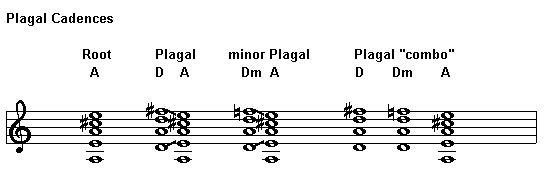
Again, if nothing else I hope that this causes you to listen to the difference in the two resolutions. The minor plagal, as I’ve said, gives me more of a feeling of finality. Using them both in sequence (IV to IV (minor) to I) (I’ve called this a “plagal combo” but that sounds like something you’d order at a fast food restaurant) really accentuates this sense of closure. This is caused by the descending F# and F notes which ultimately resolve to the E. Having these notes played so prominently on the 1st string certainly helps.
In the world of power chord rock, these kind of subtleties tend to be left by the wayside. Since most power chords leave out the third of any given chord altogether, the authentic cadence tends to rule the roost.
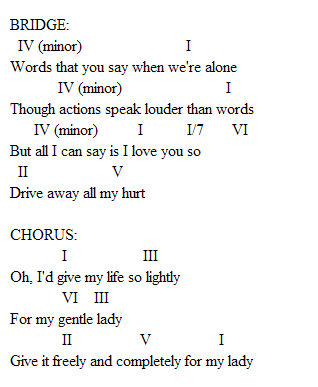
But IV minors do still crop up from time to time. Many songwriters like to use them as part of the bridge; it’s a great way to bring a surprising change of pace without really disrupting the sense of tonality beyond the point of comfort. In the Moody Blues’ For My Lady, you can see how this switch at the beginning of the bridge initially throws us off guard but ends up resolving back to the root at the start of the chorus quite nicely:
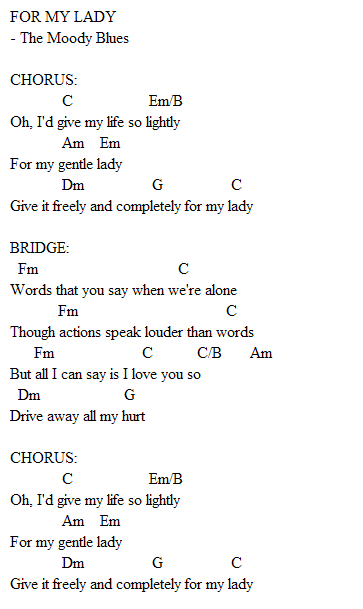
Bonus points to those of you who spotted the descending bass lines in the first line of the chorus as well as in the final two lines of the bridge.
I’m going to write it out again with the Roman numeral designations so that you can see how it compares with our chord progression chart. Pretty favorably, wouldn’t you say? The I to III and the III to II in the chorus are the only “occasionally” progressions in the whole thing.
Meanwhile, Back At The Hotel…
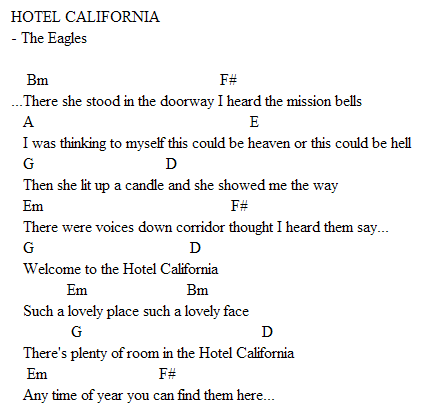
I’m actually writing the bulk of this before my last column goes online (it makes me look like I’m capable of time travel sometimes) and I’m wondering how many people are going to write me about the breakdown we did of Hotel California. In particular the part where I brought up how the last line of the verse used the fifth to close the phrase and lead up to the chorus? I might as well have been out and out saying that the chorus was going to start on a B minor, right? But we all know that that’s wrong. The chorus of Hotel California starts out with a big swinging strum of the G major chord, doesn’t it? I’ll wait here while you go check it out in the TAB files, sheet music or whatever. Yes, it is indeed D major. So did I just goof up big time or what?
Well, fortunately for me, there is this thing known as the deceptive cadence. And, also fortunately for me, it lives up to its name. It starts out like the authentic cadence in that it begins with the V chord, but then another chord is substituted for the root. Do you remember the way I freaked you out last time by playing the Ab major chord at the end of Happy Birthday? That is a great example of a deceptive cadence.
By far the most prevalent deceptive cadence used throughout music history is V to VI. VI is, note-wise, very structurally similar to I. Especially if you’ve inverted the I. Oh, right, we haven’t covered inversions yet, have we? Okay, in brief – when we discuss a chord, it is generally accepted that we are talking of it as though the root is the lowest note in the bass. When we invert a chord we are simply replacing the root with one of the other two notes in that chord. For instance, if the third is the lowest tone we would call that a first inversion chord. A second inversion chord would have the fifth it the lowest position. Here’s our G major chord and its first and second inversions:
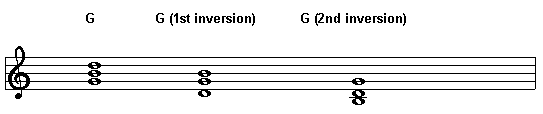
Now please don’t get all concerned about this yet, we’ll come back to it in depth in the relatively near future.
Anyway, let’s look at and listen to the difference between an authentic and deceptive cadence in C major:
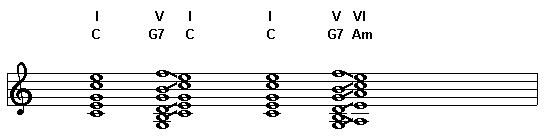
Please note that I ask you to start with the C major chord in each case in order to give yourself a sense of tonality from which to start. If you were to just play G to C or G to Am, how would you know what key you were in? Cadences only work if you’ve established a key to begin with. If you don’t believe me, try this: play G to C to G to Am to G to D and then tell me what the next chord should be. How on earth did we end up in the key of G? By not establishing C major as our “home” our ears and head automatically put us there. Talk about deceptive…
And as interesting as this V to VI cadence is in a major key (where the VI is always a minor), check it out in a minor key where the VI is a major chord:
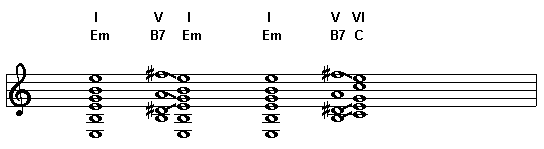
That’s pretty intense, isn’t it? Either way, V to VI is a great way for a songwriter to throw a phrase out of whack, to send a song spinning off on a wild reckless moment of abandonment. Now let’s go back and look at that half verse of “Hotel California” and follow it into the chorus. First with the actual chords:
And now with Roman numeral designations:
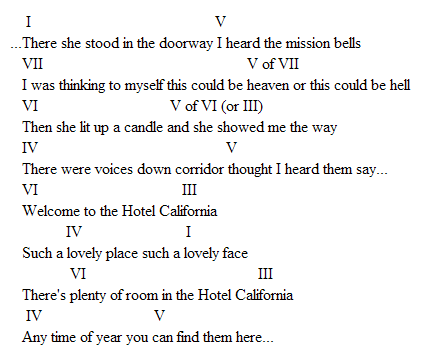
This time, for sure, the V is leading back to the Bm root that starts the second verse. You can take my word on this. Please believe me…
Dual Citizenship
Hotel California poses other interesting problems as well. For instance, what key is it in? B minor, right? How about D major? B is the relative minor of D major, after all. But listen to the first line of the chorus. That cadence alone makes a good argument for D major, so much so that the plagal cadence that follows it (Em to Bm) doesn’t have any feeling of finality to it at all, does it?
We could suggest, from a music theory standpoint, that without a V to I cadence (in D this would be A to D), the key of D major does not really get a chance to establish itself. This would be a valid point. But it would be better to talk about modulation instead. Music is a flowing, living thing. It rarely stays in the same place very long (Phillip glass notwithstanding). Melodies float over an ever-changing progression of chords. It makes perfect sense then, that the tonality of a song would also be subject to permutation.
Let’s go back to Walter Piston for a definition:
The process involved in changing from one tonal center to another is called modulation. Modulation represents the dynamic state of tonality. The word implies that there is a key in which a piece of music begins, a different key into which it progresses, and a process of getting there.
Needless to say, we are not going to get deeply involved in this subject today. But we will look at two examples of how this works, if for no other reason than to look briefly at “pivot” chords. After all, I did promise that last time…
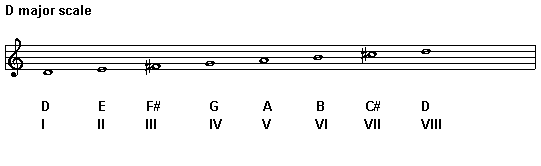
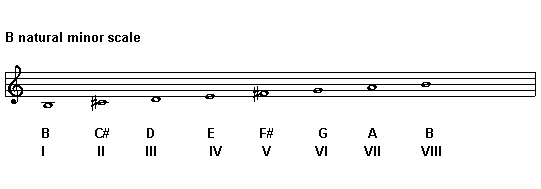
These songs will also (hopefully) help to demonstrate how tonality can shift, particularly when the relative minor of a major key is involved. Both of these songs (conveniently) are in D major and/or B minor, so let’s briefly review their scales as well as their primary and secondary chord choices:
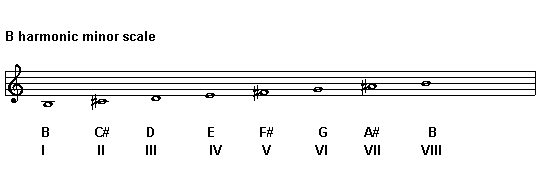
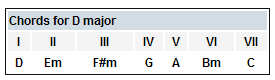
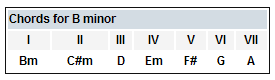
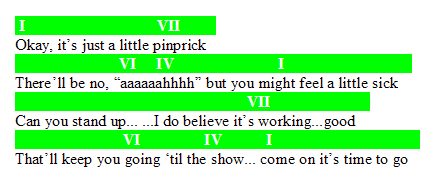
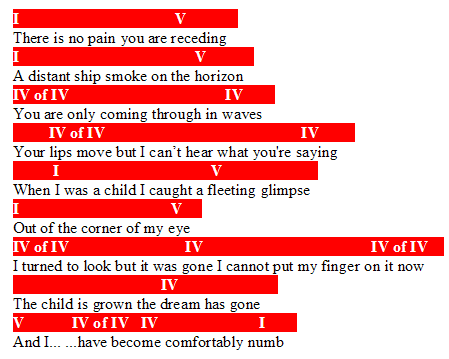
Okay, let’s examine Pink Floyd’s Comfortably Numb. When you listen to this, it is hard not to be struck by the tonal difference between the verses (or what passes for verses) and the choruses. Even though both parts of the song are in the same key signature of two sharps and even though they both share virtually the same chords, the change of mood when the singer starts in with, “There is no pain, you are receding…” is quite remarkable. Part of this is the instrumentation, but a lot of this is because of the phrasing and the cadences of the song itself. Listen and see:
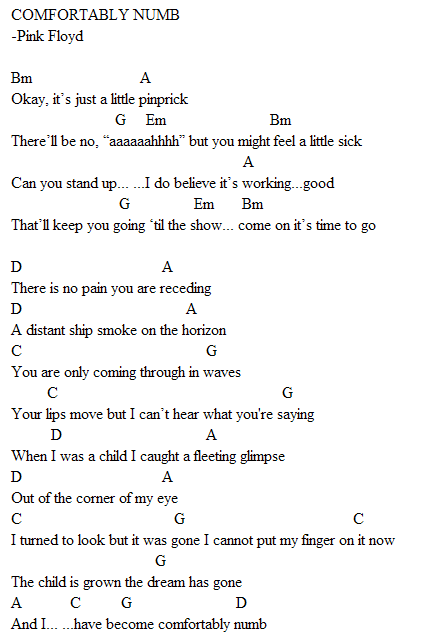
Can you hear the shift in tonality? Where exactly does it happen? To my ears, it occurs right at the first appearance of the D major chord. What really seals it, though, is the D to A and back to D again. There is nothing like an authentic cadence to nail down a tonality.
When I hear this song, I perceive it as two separate tone centers, one of B minor (the “verses”) and one of D major (the “choruses”). Because each section ends on its own root, there is a distinct division between the two. I’m going to diagram it out again, this time in Roman numerals. Thanks to the marvels of technology, I can differentiate the two tonalities. The B minor based chords will be in GREEN and the D major based chords will be in RED. Here goes:
Not all songs are this clear-cut, though. Take One Headlight by the Wallflowers. My friends and I can sit up all night arguing about which key the song is really in (I do lead an exciting life, do I not?). Here are the actual chords of the last half of the first verse and the chorus:
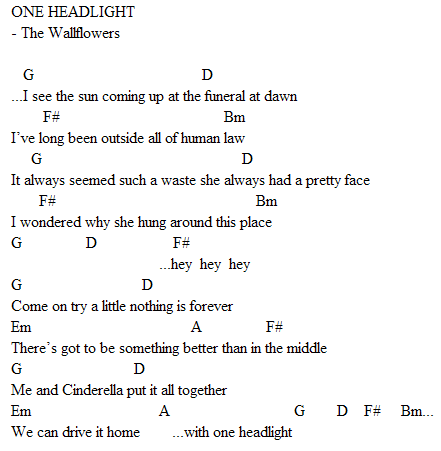
Do you hear how this song plays with you? The verses start with what would be a nice plagal cadence but then it goes right to the F# chord. So you think, “Okay, V to I, F# to Bm, It’s in Bm.” And that’s great until you get to the chorus. The F# to G you can write off as a deceptive cadence in Bm (V to VI), but the G to D to Em to A, again to my ears, roots the song in D major. Listen to it especially in the last two lines of the chorus. Hold the A when you play it and ask yourself, “If I didn’t already know that the next chord is a G, what would I play?” When I ask myself that, D is the first answer.
The tonality of One Headlight is almost constantly in flux. If you wanted to try to explain this in terms of theory, the best way would be by use of what I call “pivot chords.” A pivot chord is a chord that exists in a number of tonal worlds and serves as a bridge between two tonal centers. In this example, for instance, we could call the G chord that heralds the start of the chorus a pivot chord. It is VI in B minor (and thus completes the deceptive cadence F# to G) and it is also IV in D major, so it also functions in the plagal cadence of G to D. It also works in reverse when you come to the end of the chorus and go back into the chord progression of the verse.
Let’s take one last look at Jakob Dylan’s song. This time, though, I’m going to use the Roman numeral designation, again with B minor in GREEN and D major in RED
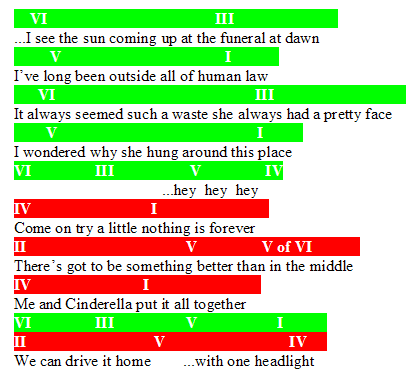
One of the things I really like about this song is the V of VI to IV progression. It’s used in more songs than you’d think. How often have you seen an E or E7 to F progression in the key of C? It’s not only a classic deceptive cadence (V of VI should normally resolve to VI, of course) but it just sounds very dynamic.
Boy, we’ve certainly covered a lot of ground here, haven’t we? If nothing else, this should show you that while theory is a terrific tool, there can be dangers on using it as your only tool. Sometimes something just sounds right and then you just hope to get the theory to explain it as best as it can.
Anyway, as always, please feel free to drop me a line with any questions, comments, concerns and such. Until next week…
Peace.