Guitar Music Theory FAQ

We at Guitar Noise have prided ourselves over the years on being able to give guitarists and other musicians the theory they need in a painless manner. So if you want to get the easiest introduction possible to music theory or simply just brush up on the theory you already know check out the featured lessons on our Music Theory for Guitar page. This page answers many of the questions we’ve received over the years.
-
Theory can increase your ability as a player dramatically, and since it’s always a good idea to learn more, theory is another bit of knowledge to acquire. Theory can help you work with other musicians such as keyboardists, horn players, other stringed instrument players. Theory can dramatically help you form a song, understand what other people are talking about, and learn about the basic structure of music in its “theoretical” form.
From scales, to keys, to chord construction – they all involve theory, and knowing it will help you resolve any confusion you might encounter. It also helps in communicating your music to others – mainly musicians, but yes, others.
So the bottom line is, why not? Theory might seem hard, but didn’t another hobby that you took up and now enjoy seem hard at first?
To get started or brush up on theory read the article Theory Without Tears and then check out our music theory for guitar page.
-
One of the biggest problems that faces any beginner is worrying about the tremendous amount of things to practice and memorize. I’ve been playing for over 25 years and I am still finding out new things to practice and memorize! No lie.
Like it or not, you cannot learn everything at once. No one can. But as long as you are enjoying playing you will keep practicing and you will one day wonder if there ever was a time when you didn’t know the things you know now.
What you need to do is to develop a practice plan, a way to focus on a few things at once. If you haven’t done so, you might want to read my piece on practicing called A Question of Balance. It might give you some help in this area.
You should definitely learn where all the notes on the fretboard are. I tell my students not to memorize the whole fretboard right off. Start with the “main frets” – the notes on the fifth and seventh frets, for instance. See, if you know what the notes are at certain point on the fretboard, you’ve taken away a lot of the “tremendousness” of the task. How much of a stretch would it be to then learn the third and ninth frets? You’ve got a third of it already down!
And you might want to start out with a simple pentatonic scale (I recommend learn the Em pentatonic (E, G, A, B, D) first since it’s one of the easiest to memorize) but you should do this in such a way that it’s fun. Work a practice based around some songs you like or make a tape recording of yourself playing the blues in E and then try to come up with some leads.
The more you enjoy yourself the more you will want to learn.
-
I don’t know if this will be easy or not, but there is a distinct pattern to learning these. And it’s really not that hard. The main thing to remember is that they always go in sequence. If a key has two flats, for instance, one of those flatted notes is the same as the flatted note in the key with one flat. If that sounds confusing, hopefully it won’t be as we move along.
First off, we agree that C has no flats and no sharps. What I like to do is to progress in either direction from there. Usually, when I hit Gb or F# I call it quits because they are the same key.
Okay, flats first. The easiest thing (for me) to remember is that the keys progress in 4ths (F, for instance, is the fourth of C) and that the flatted note is also the fourth in the new scale. In the example of the key of F, Bb is the fourth. Not only is it the fourth, though, it is also the next key in the sequence! This makes things very easy:
C – 0 flats
F – 1 flat (Bb)
Bb – 2 flats (Bb, Eb)
Eb – 3 flats (Bb, Eb, Ab)
Ab – 4 flats (Bb, Eb, Ab, Db)
Db – 5 flats (Bb, Eb, Ab, Db, Gb)
Gb – 6 flats (Bb, Eb, Ab, Db, Gb, Cb)Now sharps are a little harder, but there are a couple of ways to look at it. First off, going from C to G (which is the key with one sharp) is moving in the intervals of fifths. The next key after G would be the fifth of G which is D. For me, the key is remembering that the newest sharp will always be a half step lower than the root. G has one sharp and it is F#, which is that half step lower. D is next so it will have F# (because it has to carry over to the next key) and the new sharp will be C#. Here we go:
C – 0 sharps
G – 1 sharp (F#)
D – 2 sharps (F#, C#)
A – 3 sharps (F#, C#, G#)
E – 4 sharps (F#, C#, G#, D#)
B – 5 sharps (F#, C#, G#, D#, A#)
F# – 6 sharps (F#, C#, G#, D#, A#, E#)If you remember that flats progress in fourths and sharps progress in fifths and simply remember the first flat or sharp, then it’s as simple as this:
Bb, Eb, Ab, Db, Gb, Cb
F#, C#, G#, D#, A#, E#I hope that this helps. It may not seem like it but after a while it becomes second nature to not only know these, but also the relative minors!
-
The time signature (along with the key signature) is one of the first things you encounter when you read music, so you might as well learn just what it means at some point, no? The time signature usually consists of two numbers written one on top of the other, almost like a fraction except there is no line (other than the lines of the staff and that doesn’t count). These provide you with two important pieces of information about the song that you are going to play. The top number tells you how many beats are in a measure (and we learned about measures in Before You Accuse Me). The lower number (the “denominator” if you will, the number that sits on the bottom) indicates which note is going to count as “one beat.” The vast majority of music you are likely to encounter will be in 4/4 timing:

Sometimes you will see “4/4” timing written out as “C.” “C” and “4/4” are interchangeable. And if you’re really interested in a theory of the origins of this symbol, check out the “Email of the Week” in this old newsletter: Newsletter Vol 2 # 4.
As well as “C” there is also a “C” with a vertical line slashing it – (C)
It looks like the symbol for a penny. This is known, appropriately enough, as “cut time,” or

There are also songs, many marches in fact, which are in 2/4 time. And you have undoubtedly heard songs that use 3/4 timing as well. Waltzes are in 3/4:

Probably eighty-five to ninety percent of all songs are written in either of these two time signatures. 6/8 timing is very similar to 3/4 in that it has the same kind of “triplet” feel. It’s easier to count in groups of threes rather than sets of six, isn’t it?

For a complete lesson on time signatures check out the article Timing is Everything. There is also a detailed explanation with examples in the article House of the Rising Sun.
-
At the beginning of each piece of music, the staff will be followed by two important pieces of information – the key signature and the time signature.
You may not know this, but sheet music is often much more helpful than TABS in ways that benefit the player who is not concerned with playing things note per note. The key signature is the number of sharps or flats (or the lack thereof) that appear immediately after the clef. This will, much more often than not, tell you what key a song is in. Notice I said sharps or flats, not both. We’ll come back to this in a moment.
If you’ve read any of the beginner’s theory pieces (Theory Without Tears or The Musical Genome Project) you are well aware that there are more than seven notes. There are actually twelve. Some are designated by just a letter, while others are a letter and a symbol like this – # – or this – b. The “#” means “sharp” or “one half step above the note of the letter. C#, for example, is a half step above C. A “b” is a flat sign, meaning that we have moved a half step down from the note of the letter. Eb is a half step below E. And let’s note here that this does indeed mean that some notes actually share the same name. “Ab” and “G#” are, for our purposes, the same note. Here’s a handy chart:
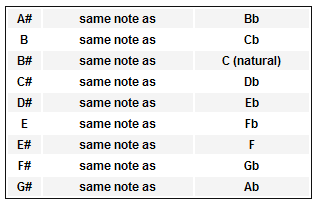
In musical notation, the symbols for flats and sharps are called accidentals. There is also an accidental for “natural” meaning that the note should be the straight letter value, neither flat nor sharp.
Why on earth would you even need a “natural” symbol? Well, that should become clear momentarily. Suppose you were writing out a song in the key of E, a fairly common key for guitar music. There are four sharps in the E major scale. See for yourself:
E F# G# A B C# D# E
Would you want to have to put a sharp notation every time you wrote one of these four notes? Of course not. What you would do is write out your sharps ahead of time, at the very beginning of the piece. This is like a big billboard saying, “Hey! Whenever you see an F, it’s supposed to be an F#, okay?” This is what the key signature does. So, how do you know what key a song is in? Well, you may not believe this, but there are rules! These rules are dictated by the formation of the major scale. Here’s a run down:
- Key of C – no flats, no sharps
- Key of G – 1 sharp: F#
- Key of D – 2 sharps: F#, C#
- Key of A – 3 sharps: F#, C#, G#
- Key of E – 4 sharps: F#, C#, G#, D#
- Key of B – 5 sharps – F#, C#, G#, D#, A#
- Key of F – 1 flat: Bb
- Key of Bb – 2 flats: Bb, Eb
- Key of Eb – 3 flats: Bb, Eb, Ab
- Key of Ab – 4 flats: Bb, Eb, Ab, Db
- Key of Db – 5 flats: Bb, Eb, Ab, Db, Gb
There is a lot more to figuring out what key a song is in. For more on this topic we suggest you read the series Determining the Key of a Song. And to learn more about key signatures you should check out Your very Own Rosetta Stone and Key Changes.
-
If you ever decide to play music with musicians other than guitarists (and bass players don’t count!) you will very quickly run into a situation where one of you knows a particular song in one key while the other knows it in another. The guitar has a natural disinclination towards keys that contain flats. Unless you’re incredibly adept at barre chords knowing how to transpose a song will prove to be an invaluable skill. And not only is it easy to learn, it’s actually a lot of fun when you get the hang of it.
You will need a capo for transposing so you might want to read The Under Appreciated Art of Using a Capo first.
This is how it works. If I put my capo on the first fret, every chord I play has now moved up a half step. An A chord is now a Bb (or A#). An E minor is now F minor. If I put it on the fourth fret, everything is now up two whole steps (four half steps). A C is now an E. An A minor is a C# minor. The following chart will give you some of the basic chord transpositions:
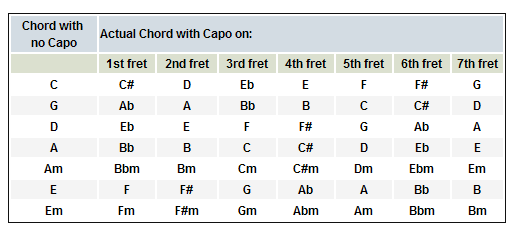
As well as reading The Under Appreciated Art of Using a Capo you should also check out Turning Notes Into Stone for a more complete lesson on transposing keys.
-
The reason why we just don’t play three strings only is because that would very hard to do, especially if you were strumming fast.
Chords are made up of multiples of the three notes. All the three note thing tells you is that you’ll see those three notes only, in that chord. The reason why you learn those other chords with sevenths and nineths is because they help with tonal variety and connect melodic phrases sometimes better than triads can.
As far as knowing which ones to use, the notes in that chord you want to use should be in the key you are in. If they are not, then there should be a reason for using that chord. For instance, in the key of C major, there is no A7 chord right? But if you use it and resolve directly to a d minor chord, a chord in the key of C Major, it’ll sound great.
-
Here’s our C major scale:
do re mi fa sol la te do
C D E F G A B CAn interval is the distance from one note to the next. We name the intervals according to their place on the major scale. From C to E, for instance, is called a third (okay, a major third). From C to A is a sixth. D to B is also a sixth. Do you see this? The starting note becomes your root and B is the sixth note in a D major scale. Using this same logic, D to F is not a third, but a MINOR third. How about E to A? Right, it’s a fourth. And E to C? Right again, E to C is a minor sixth. An eighth, from C to C, D to D, F# to F#, and so on, is called an OCTAVE. I’m sure you’re all familiar with that one.
For detailed lessons on intervals check out the lessons Happy New Ear and A Study On Intervals.
-
Try playing a G chord followed by the E minor. Can you hear how similar they are? If we look at the notes that make up the chord, we see the following:
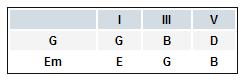
Notice that these chords share two of their three notes. This is because E minor is the RELATIVE MINOR of G major. The relative minor shares the same notes in the major scale, but it’s root is the sixth of the major. Here’s our G major scale:
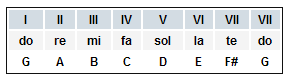
In order to find the relative minor we look for the sixth and make that the root. Therefore, E minor is the relative minor of G major and the E minor scale would look like this:
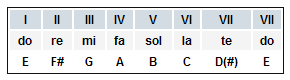
Here’s a chart of a few major/relative minor keys you can use (but please feel free to make out one of your own, listing all twelve possibilities as a test!):
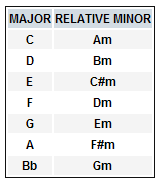
This answer is a small extract from the article Happy New Ear. be sure to check out the complete article for more exercises and examples.
-
This is a note in the melody (or the chord) that is taking part in the transition from one chord to another. Passing tones help to create “tension” between the melody and the accompaniment that is released when the melody and the chord are “resolved.”
Good music, much like art, theater, literature, or relationships and life, for that matter, tends to be a series of tensions and resolutions (or releases) of varying intensities.
A lot more has been written about this in the article Multiple Personality Disorder.
-
A question on harmony, or perhaps the antithesis of harmony: What do people mean by “dissonance” and other such terms when talking about chord changes?
Dissonance, according to the dictionary, is “an inharmonious combination of sounds; discord; any lack of harmony or agreement.”
When we listen to music, certain notes sound pleasing when played together. For many people, the interval of a major third (C and E, for instance, or G and B, etc.) is perhaps the most pleasant, or harmonious sound.
Dissonance is when we create a sound that is not harmonious. There are degrees to how harsh the dissonance can be. If you were to play a C (5th fret, G string) and a C# (2nd fret, B string) together, it would sound as if the notes are clashing.
In a sense, they are – you feel that this combination of notes wants to turn into something else. It’s almost as if you’ve caught them in mid-metamorphosis. Play these notes again and now slide your finger on the C down to B (4th fret, G string) and at the same time slide the C# up to D (3rd fret, B string). Can you hear how the dissonance completely disappears? It’s the interplay between dissonance and harmony that helps to add a dramatic, almost dynamic aspect to a song.
Dissonance can be created in countless ways. You can add a dissonant note to a chord (even via a melody or bass line), you can play one chord on top of another, or you can play a string of chords while holding one note steady in the bass.
But the thing to remember is that not everyone hears the same sorts of dissonance. It’s a matter of what you’re used to. That C/C# thing we mentioned earlier? A jazz player would write it off as a C#maj7 and might not think of it as dissonant at all.
-
Whenever you see a number after a chord, it refers to the note in that particular scale that you should add to the basic chord. If you know that the C scale (C, D, E, F, G, A, B, C), then C6, for example, is the basic C chord (C, E, G) plus the 6th, which is A.
But sevenths are a different matter. If you see a “Cmaj7,” then this would be C, E, G and B, which is the major seventh. A regular “7” chord means that you want to add a FLATTED seventh note – a major seven which is lowered a half step so that it is one full step below the root. So a “C7” would be C, E, G and Bb.
We go over the formation of these and other chords quite thoroughly in The Power of Three and Building Additions and Suspensions. If you haven’t already done so, you might want to give those a once-over.
-
Unlike a major or minor chord where the third is a major or minor third, the seventh chord is a minor seventh unless we specify that it is a major. If I say play an A, you automatically play an A major. If I say play an A7, we automatically add the G note (minor seventh) to the chord. Only if I ask for an Amaj7 will you play the natural seventh (G#).
In music theory, a seventh is traditionally used to make a transition from the root (or I) to the subdominant (IV). This transition is called a resolution. Even the use of this term “resolution” implies that a seventh chord is incomplete, that there must be a following chord that will bring it (and our ears) to a final point.
For further study on sevenths check out the articles Happy New Ear, Sevens Threes and Nines and Building Additions (and Suspensions).
-
One of the problems in music is that people often ignore (or simply don’t know) the “standard” notation. I have been guilty of this myself simply because it can be very tedious to write out “Aadd9” all the time! There’s also another problem that is less apparent and we’ll come to that in a moment. First, let’s define the notes of the chords involved, shall we?
Okay, technically, there are very big differences between A9, Aadd9 and Asus2. If you’ve read Building Additions (and Suspensions) you might already have a handle on this. Let’s start with an A major chord:
A: A, C#, E
Any “suspended” chord means that you are replacing the third of the chord (in this case the C#) with something else, normally the 2 or 4. So an Asus2 is this:
Asus2: A, B, E
An Aadd9 is adding the ninth (in this case the B) in addition to the rest of the A major chord. To me, there is no difference between a “2” chord and an “add9.” So the Aadd9 is as follows:
Aadd9: A, C#, E, B
And finally, any “9” chord should, technically speaking, include the 7th. Usually it is the flatted (or dominant) 7th but it could easily be the major 7th as well:
A9(usually): A, C#, E, G, B
A9(w/major 7th): A, C#, E, G#, B
Okay, I hope that clears up what these chords actually are. Now let’s look at why there is often confusion as to what to call the chord. Suppose you see a chord written out as follows:
E – open
B – open
G – 2nd fret
D – 2nd fret
A – open
E – don’t playHere the notes are A, E and B. Technically, this would be an Asus2, since there is no C# to be found. But the guitar is not like the piano where you always have all the necessary notes (relatively) close at hand. Often, especially with chords that have more than four notes, you end up leaving one or more off. If you were playing this chord with a pianist, you would sound okay whether the pianist were playing an A9, an Aadd9 or even an A11 or A13. If you wanted to play a true A9, then you’d need the G and C# notes so this would be one possible fingering:
E – open (E)
B – 2nd fret (C#)
G – 4th fret (B)
D – 5th fret (G)
A – open (A)
E – don’t playAnd you can see where that might be a pain. This is why it’s important to not only know what notes a chord is made up of but also what voicings will give you exactly what you are looking for. For instance, when I see A2 or Aadd9, I tend to play it like this:
E – open
B – open
G – 6th fret (C#)
D – 7th fret (A)
A – open
E – don’t playThe bottom line is that whoever is writing out the chords often calls it whatever he or she thinks it is. For better or worse. The best thing is to also have in your power to know what else it could be. Sometimes it is up to you to make the call but, as always, knowing what choices you have at your disposal helps matters immensely.
-
If C Ionian is C D E F G A B C and D Dorian is D E F G A B C D, then what is the difference between the two?
The difference is not so obvious. To fully appreciate the difference, you need to play a chord that has a C in it over the C Ionian, and play a chord that has D in it over D Dorian. This will light up the mode. You can’t really hear the difference by just playing the scale by itself.
By the way, you don’t have to play them in order, or diatonically. But you really need to emphasize the mode you want by ending on that note. So for Dorian, you really want to end that melodic phrase with a D note.
-
When building a chord like “C13th,” there are seven notes shown. The most notes that can be covered by one hand on the fretboard at one time is six. So, which note (s) do you leave out in order to actually play the chord?
As you can imagine, there’s a lot of debate amongst music theorists as to what is the “proper” thing to do in such a situation when you have a chord that has more notes than you are able to produce.
Traditionally, the fifth or the third would be left out (usually in that order). Believe it or not, there are instances, though, when the root is the “missing” note.
But the real determining factor is what notes you are able to finger (or not finger) on your fretboard. For instance, if you strum your guitar (standard tuning) without putting any fingers on the fretboard at all you would have an A11. The notes, from low to high, would be E (fifth), A (root), D (eleventh), G (seventh), B (ninth) and E (fifth again). Here the third (C#) is the missing note. You could always add this by playing it on the 1st (or 6th) string but it sounds perfectly fine as it is.
Generally a good rule of thumb with 9th, 11th, and 13th chords is to really try to include the seventh along with the root in order to give it some sense of identity.
-
Diminished chords are very cool, and easy to understand. Diminished chords serve a cadential function just like a dominant 7. Just like all bar chords these are universal shapes and can be moved anywhere on the fretboard and you will come out with a diminished chord as long as the shape is retained.
For the complete answer read What are diminished chords?
-
Technically speaking there really is no such thing as the diminished power chord. A power chord by definition is, as you pointed out, simply the root and the fifth of a scale. The term “power chord” is strictly a contrivance of the electric guitarist. You can, however, play two notes, one being the first, or root, and the other being a diminished fifth. This is called playing an interval. It is also a very interesting interval, theory wise, because the diminished fifth is as far away as you can get from the root.
For the complete answer read How are diminished power chords formed?
-
There are times (quite often in fact) when you will be playing a song in one key, just for example, let’s say the key of C, and you will come upon a chord which doesn’t really exist in that particular key, but hey, there it is. It sounds perfectly fine though (in the context of whatever particular chord progression that you’re playing) so maybe you won’t think about exactly how this chord “fits” in.
Let’s look at a few chord progressions in C to demonstrate this, okay? Try them out yourself if you want to.
- C Bb F C
- C E7 Am Dm D7 G C
- C A D G C
Now, as we were saying, since the key of C has no flats or sharps, any chord that contains any flat or sharp is not actually part of the key of C. Where did it come from?
What music theory tries to do is to look at these chords in terms of how they fit into the flow of the chord progression. All chord progressions are simply movements from one point to the next, hopefully they will eventually bring us back to the home (or root) chord.
Sometimes in moving from one point to the next, we are actually “borrowing” chords from other keys (here the Bb in #1, the E7 and D7 in #2 and the A and D in #3). Theory tries to label these chords in terms of the keys from which they are borrowed. We (usually) try to determine where they came from by where they are going to (how they are resolved).
Just to make sure we’re on the same page, let’s look at the primary and secondary chords in the key of C major, shall we?

Are you with me? Okay, in example one (C, Bb, F, C) we need to ask about that Bb. C, F, C we already can make out as I, IV, I. Since the Bb is aiding in the transition from C to F, let’s theorize (I know bad pun) that Bb must have some relation to F. And sure enough if we look at the chords in an F major scale we will see:

In the F scale, Bb is IV. But what we want to do as music theorists is to give the Bb some kind of context in the key of C. So we have to relate it somehow to a chord in the key of C and that’s exactly what we do – we call it IV “of” IV, meaning that it is the IV of F (which is the IV of C).
Almost always (and yes there are ALWAYS exceptions) an “of” chord will be a IV or V of something. In example #2 (C, E7, Am, Dm, D7, G, C) we borrow two chords (the E7 and D7) from other places. Again if you listen to where the chords take you, it’s fairly easy to establish that the E7 is resolving to Am and the D7 to G. So we would write out this progression like this:

Are you still with me on this? Because sometimes, just to show you how tricky things can get, a chord might not be resolving to one of the chords of a given key. Then you have to be a bit of a detective to figure things out. Example #3 (C, A, D, G, C) is a typical example of this sort of thing. Here not only are A and D obviously “borrowed” from other keys, but the A resolves to the D which, since D is not part of the C chord group, presents us with a bit of a problem.
What we do in this case is to work backwards. Let’s mark what we know, okay?

Since G is the resolution for the D chord, we can (and rightly so!) make the case for D to be V of V. But that still leaves us with the A chord. But since A is the V of D, we basically create a secondary layer to describe how the A relates to the G. A would be V of V in G, correct? So we basically write that out in terms of the G to the C –

Aren’t you sorry you asked!!!
Seriously, This is an absolutely fascinating concept that many writers use (even though they may not know it). If you’d like to get a bit better handle on it, I suggest you read my column You Say You Want A Resolution.
-
I was talking to a friend who is a music teacher and to test me he asked me what the seventh would be in a F#maj7 chord. I eventually said the answer was F, he said the answer was actually E#. I was a bit confused by this, I am familiar with the enharmonic principle, but I had never heard anyone mention E#. So I went and dug out my books and looked up a couple of illustrations of the circle of fifths, and sure enough under F# in all the illustrations were the notes F#,G#,A#,B,C#,D#…and E#.
It’s questions like this that give music theorists a bad name…
Okay, technically you are both right. But in terms of the “classical” way of looking at things, E# is considered the correct answer. Why? Because if you look at the key signature for F#, there are six sharps (F#, C#, G#, D#, A#, and E#). And it’s the same thing when you look at the key of Gb – there will be a “Cb” in there. So the rule of thumb is to think of how the key signature would be written in standard notation and then to use that as your guideline.
This sort of thing though is what tends to scare good people away from music. It’s no skin off anyone’s nose to say, “Yes you are correct, however, this is how most scholars would like you to answer this…”
And in case you are interested – it is possible to argue the case that E# and F are NOT necessarily the same note. Think about this – on a violin or similar stringed instrument that has no frets (including the fretless bass guitar), it is wholly possible to make your notes sharper or flatter than they would be on a guitar, piano or any other instrument. It is simply a matter of moving your finger an infinitesimal distance one way or the other from the core note. This is why you have to have a great ear to play one of those things…
-
Technically the key of a song does NOT change with each chord change – things could get very weird if that were the case. For example, in the key of A you could solo for four bars on the A minor pentatonic scale then use the D minor pentatonic scale for two bars and back to A. You shouldn’t think of the switch to D as a “key change” per se but you can take advantage of the brief shift in modality to use a D minor pentatonic scale for the lead over these two measures. You can also use the same logic if you so desire to play an E minor pentatonic in the one measure of E (V) that comes up later on.
Two interesting things: the A minor pentatonic (A, C, D, E, G) could be used throughout the entire blues progrssion (I, IV, V). But if you wanted to try something interesting, you could also use the D minor pentatonic (D, F, G, A, C) either throughout the entire song or at least through the two measures of A after the two measures of D, just to spice things up a bit and create a very interesting feel.
-
House of the Rising Sun is an incredibly interesting song because it flits between all three of the minor scales (natural, harmonic and melodic), never staying in one scale for long. However, it is always in A minor.
You could go a couple of different ways with this. First off, A minor pentatonic (A C D E G) will work over most of the progression. The only thing that could really hurt would be wailing on the G note over the E chord. True, G is a blue note in the E blues scale and the E minor pentatonic so if you use it wisely you may be fine.
What would also work would be to remember that leads are built upon more than just scales. Using chord shapes along “chord substitutions” will give you some very cool lines. For instance, Am is made up of A, C and E. If you kept those notes cycling in a triplet like this:
E – 12 – – – – – – – – – –
B – – – – 13 – – – – – – –
G – – – – – – – 14 – – – –through the first part of the chord progression, you’d have this:
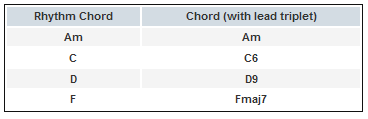
and that would sound very dynamic.
For more on this song check out the song lesson House of The Rising Sun and find out some interesting history in Legendary House.
I Still Haven’t Found What I’m Looking For
Bono Tip: What do you need help with? Tweet it to us at @guitarnoise1 and we’ll see what we can do.