A Horse With No Name – Adding Some Personal Touches

It’s fairly safe to say that when many of us took up the guitar, we had an idol, a player to emulate. It could have been (and could still be) someone famous (Page, Vaughn, Atkins) or someone we knew personally (parent, sibling, relative, the “kid down the street who had his/her own band”). And, like as not, we probably geared our early guitar “studies” (such as they might have been) to copying the riffs and tones and even every playing mannerisms of our heroes. Such has been the life of the would-be guitarist throughout the ages.
But at some point, the individual personality of the fledgling guitarist starts to emerge. It may be in very minute details, like a favorite picking pattern or a fill that he or she does extremely well and (consequently throws in wherever the situation allows). From these basic riffs, fills and rhythm patterns will blossom leads and more complex techniques. We call this growth a musician’s style.
So how and when does one start to develop a style? Well, personally (obviously), I think that one’s style starts at day one. When you learned your first song, did you copy the strumming pattern right off the recording? Maybe you followed your guitar teacher’s suggestions. Maybe you came up with something all your own. And maybe you did all of the above.
It’s like cooking or telling a joke. You get the basics from somewhere and then you add your own touches (or not) to make it fit your tastes (or to cater to someone else’s tastes). Well, that’s essentially the same thing that happens with your playing.
In our lesson on “Horse With No Name,” you learned the basics of the song along with some simple strumming patterns. Today we’re going to work on adding a bit of accessories to the basic model. Feel free to use any of the ideas, riffs or leads we develop here or use them as a foundation on which to create your own musical ideas.
Picking And Choosing
It amy seem that I probably never play the guitar ’cause I seem to spend so much time thinking about things. The reality is that there are a lot of things to think about before (and while) playing. Most of it takes less time to deal with then you will spend in reading this sentence. Do I know the song? How well do I know this song? How many people are playing the song? What instruments are they going to play? What sort of role should I play? What role do I want to play? Do I intend to sing? What key is the song in? Do I want to play it in that key or use a capo? What chords changes are there going to be? Will those chord changes affect the scales I plan to use? Do I need to rethink my fills or leads? What sort of tone or effects do I think will work? All this (and more) passes through my head when I’m getting ready to strum the first chord or join in with a fill or sing a harmony part or whatever.
Let’s start with the obvious things first. As we discussed last time, the song is in the key of E minor and consists entirely of two chords: the aforementioned Em and the mysterious Dadd6add9. Each chord lasts for four beats; there is no variations to the pattern. It truly doesn’t get much simpler than this.
You’ll also recall that last time, we came up with this simple strumming pattern:
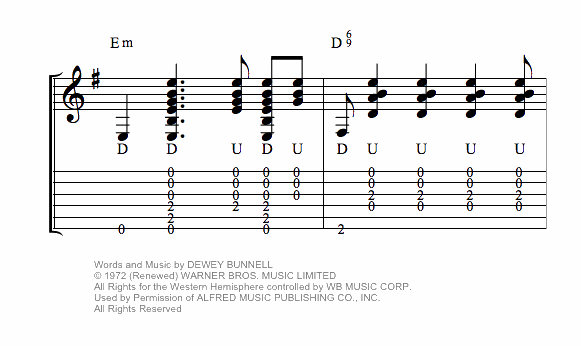
Listening or playing the song again, I realize that virtually all the singing takes place in the Em measures of any given verse. The last two beats of an Dadd6add9 measure, except during the chorus, are usually free of vocal traffic. This makes those spaces particularly attractive spots to throw in a fill. I don’t have to worry about stepping on the vocal line (which could be bad) or trying to sing and play something a little complex at the same time (which, in my case, could be really bad!).
Now a fill, as we discussed in Tricks Of The Trade, need not be some flash of technical wizardry. It can be something as simple as a well placed hammer-on:
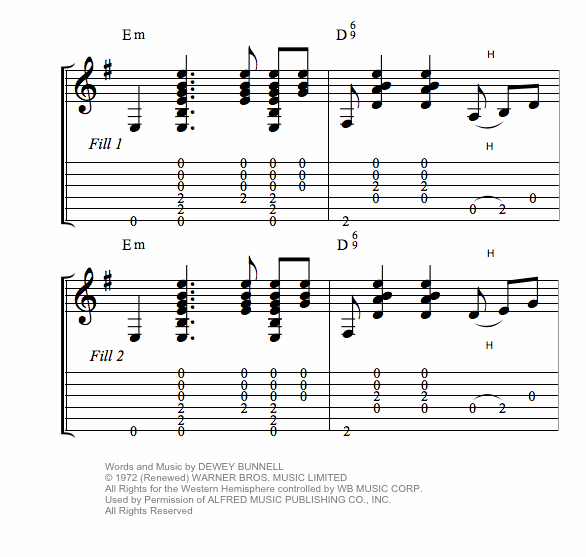
I could easily use either of these fills while playing the song by myself or while playing with someone else. If I trust my fellow guitarist(s) with the rhythm, and if someone else were singing the lead, I might attempt something slightly more complicated, like any of these:
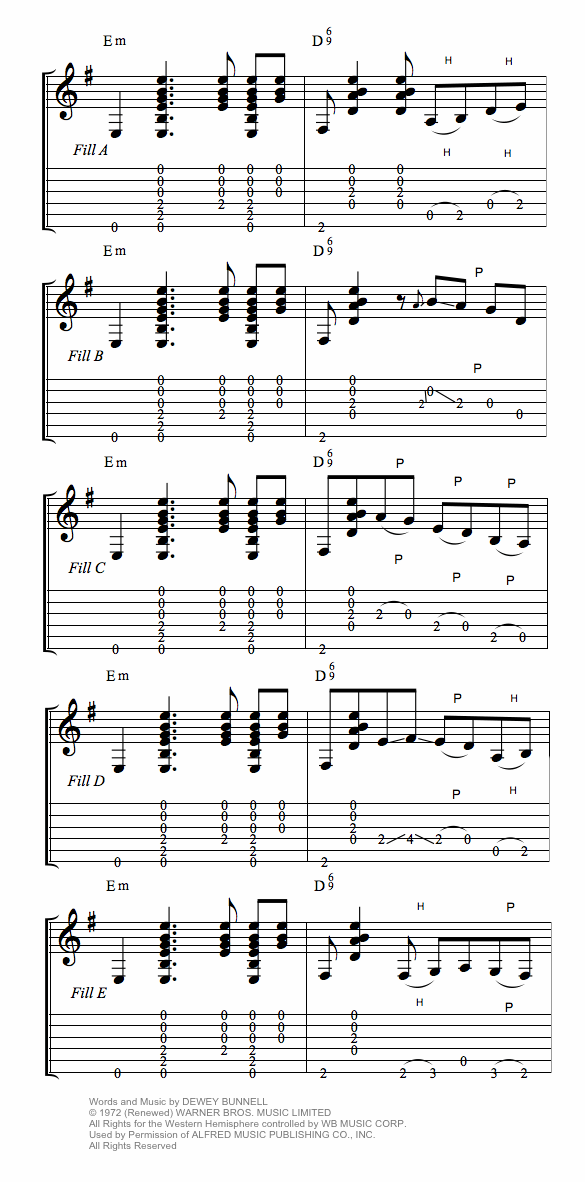
Again, there’s nothing phenomenally complicated here. Fill A is an “expanded” version of our first fill. Fill B utilizes a slide from the A note to the B and then some pick-offs to get us back again. More (and simpler) pick-offs are used in Fill C while, a combination of slides, pick-off and hammer-ons is used for Fill D. Fill E is something I might use if there is no bass player and I want to give a bit more interesting bottom to the song.
Mood is important, too. If I think it’s important to have something to steady the beat, then I will not only play something simple, but play the same one over and over again. If I’m being a bit playful, then who knows what fill might pop up at its designated place.
Let me stress that these are not “be all and end all” transcriptions. Any riff or fill you learn is meant to be played with, to be tinkered with so that you can use it when and where you think it might add a bit of zest to a song. Add an additional note or two here or there. Stretch or shrink the timing to your liking. Think of a fill as silly putty, if you will. But above all, have fun.
The Origin Of The Species
Ah, but I hear someone asking the age-old question, “Where do they come from? If I only have notes, how do I turn them into a fill or a lead?” This answer is going to really disappoint some of you (and really excite others). There is no “formula.” You simply arrange the notes into a way that (A) you can play, (B) that sounds good, to you at least, and (hopefully) (C) that fits the song.
Points A and B are almost constantly evolving as you learn to play. By starting out with riffs and fills, you subconsciously develop playing patterns, just as you do with strumming patterns. As a consequence, certain things might be easier for you to play than others. Some people learn “the box” and work it to death. Eric Clapton has mentioned in interviews that he tried to learn as many riffs and leads as he could off records and then worked on incorporating them (or altered versions of them) into the music he was playing.

Notes (and the patterns in which we play them) are often dictated by scales. The scales are (again, usually) determined by the tonality and the modality of the song itself. This is where things can get a bit confusing. Take Horse With No Name, for example. The song is in E minor. E minor is the relative minor of G major. So if we were to look at the music for this song, it will undoubtedly be written with one sharp (F#) on the staff. And this is indeed the case.
But, as we’ve read in Scales Within Scales, there are many E minor scales and it is conceivable that we don’t want to even work with any of them. How do we choose what to use? In most cases, the music will initially do that for us. Since there are only two chords used in the song, let’s look at the make up of each:
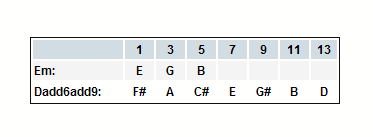
Remember, too, that we do not play all the Dadd6add9 notes on the guitar. With the fingering used in the song, the G# and C# are eliminated from the chord.
Technically, we can make the case that a G could easily stand in place of the G#, especially if we call decide to call our Dadd6add0 an F#m (b)13. This would be much in keeping the center of the song in E minor and that is something that is not open to debate. Everything about the song – the chords, the melody and the harmonies – dictate that the tonality of this song is E minor. The Em chord (with its notes of E, G and B) is its tonal center.
But the “flavor,” or modality, is still up for grabs. Looking at all these notes (and eliminating the G# for the reasons we’ve discussed), I see that there are two sharps (F# and C#) to deal with. Two sharps dictates the key of D major. Again referring to Scales Within Scales (or to our soon to be new-and-improved scales and modes page), I know that in this scenario I can use an E Dorian scale in order to get the notes that I want.
Another question, though: Why can’t I simply use the D major scale? What is the difference between the D major scale and the E Dorian scale? And the answer to this is probably as close to Zen as any answer I’ve ever given you: There is no difference between the two and there is every difference. Here’s why:
Each note in the E dorian scale has an exact counterpart in the D major scale. But because you start (and end) one scale on D and the other on E changes the whole color of the scale. If you refuse to believe that, try singing each scale note for note (and use an instrument to accompany you). Sing “do, re, mi…” if you like or simply to phrases. By making E the focal point (the “I,” “do” or root) of the scale, by making E the “center” of tonality, you change how each and every note corresponds and interacts. Yes, for all intents and purposes, you are playing the notes of the D major scale but they no longer have anything to do with that particular tonality. This is a difficult concept to grasp and we will be devoting more time to it this winter, but I hope this gets you started to think in the right direction. You can check out any of our many articles on the subject here at Guitar Noise, such as Part 6 of our Turning Scales into Solos series.

Take a look at the lead from the original recording and you should see that it’s pretty much created from simply going up and down the E Dorian scale:
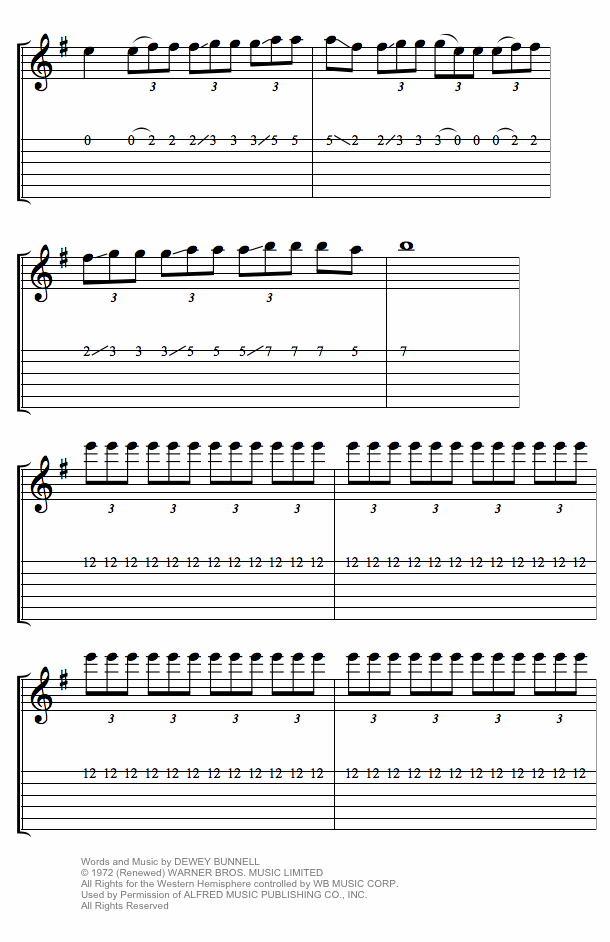
It’s important to point out here that this lead finishes with three different acoustic guitars playing lead in the final two measures. One trills away on the E note at the twelfth fret of the high E string (as shown in the last example) while the other two play a series of descending triplets like this:
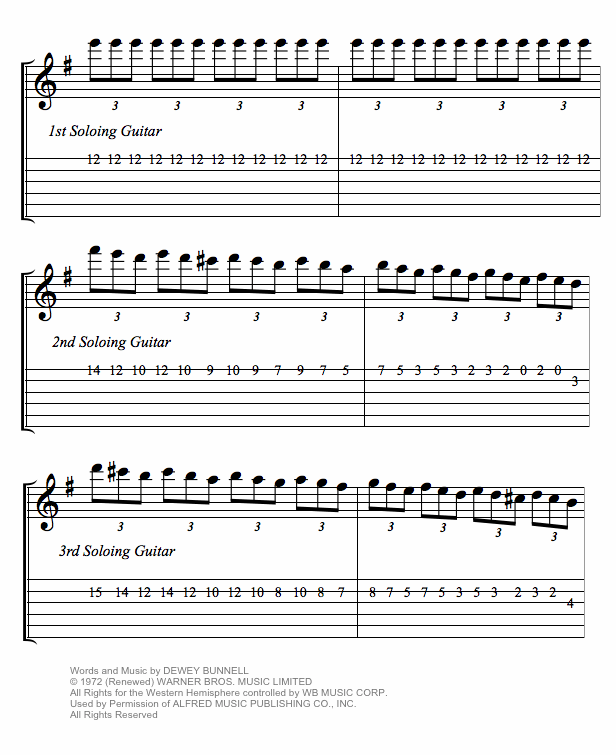
It’s close to impossible to play all three of these guitar parts at once on a single guitar, which is one of the reasons why you shouldn’t worry a lot about playing everything according to the original recording. However, you can use the open high E string as a droning note and play one of the other two guitar sequences an octave lower as well, las in the first two of the following these examples:
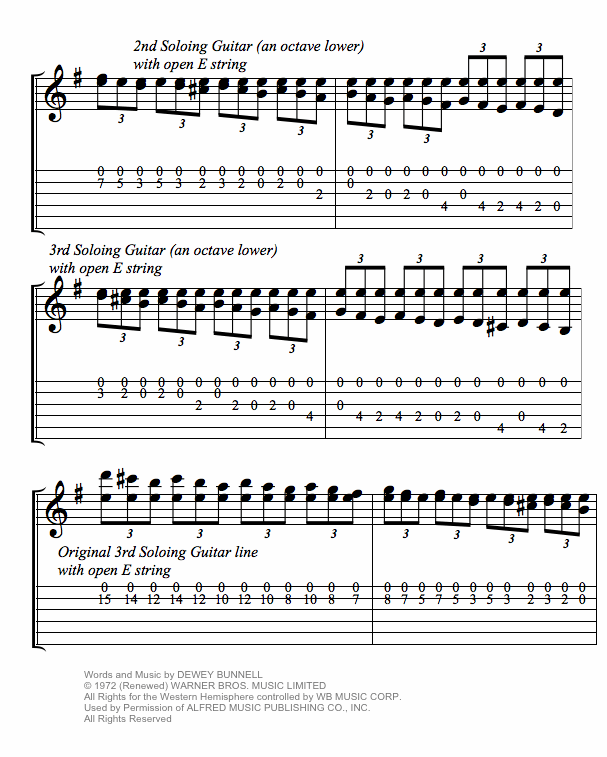
The last line of the above example uses the original “3rd Soloing Guitar” line from Example 5 and pairs it with the open high E string. You might find this the easiest of the three to play.
Making adjustments of this nature is part of how you develop your own style. It’s also a perfect example of what I told you at the beginning of this section. Point A, being “what I can play,” will (hopefully) always be improving and, because of that, my leads will become more interesting (technically and musically) as I evolve as a guitarist. And as I expand my musical tastes (and abilities), “what sounds good” (Point B) will also change radically. It’s up to me to make sure that Point C (“fitting the lead to the song”) follows suit.
This is how your “style” develops. It is a natural process that will occur as fast or as slow as your musical abilities do. Let it happen.
Sharing The Wealth
And then share it with the world. I can tend to go on and on about things, but this will always bear repeating: music is meant to be shared. It is its nature. The high that you get from playing is amplified enormously when playing for and (more so) with others.
As always, please feel free to write in with any questions, comments, concerns or topics you’d like to see covered in future columns. You can either drop off a note at the Guitar Forums or email me directly at [email protected].
Until our next lesson…
Peace
Karl
October 24th, 2015 @ 12:50 pm
Always wanted to get a broader palate for drone string leads and that helped a lot.
Juan David
January 15th, 2014 @ 10:20 am
Thanks a lot!