
Losing My Religion – R.E.M.
This lesson, Losing My Religion by REM from their 1991 release, “Out of Time,” is kind of a cross between an “Easy Songs for Beginners” and a “Songs for Intermediates.” It’s easier than many of the other Guitar Noise Intermediate pieces we’ve learned, yet it does have a number of concepts and techniques that beginners will have to work at a bit.
Which is not to say that beginners won’t be able to play it. Au contraire! In many ways, this is a great song to further develop some of the arrangement ideas we continually touch upon many of our Guitar Noise song lessons. And I think you’ll find it’s been planned out in such a way to make things easy regardless of whether you consider yourself a beginner or an intermediate. The key is to go through it step by step, taking your time.
When I listen to this song on the CD, I’m struck by a couple of things. First, the song is in A minor, a fact born out by (a) playing along with the recording with my guitar and (b) looking at a copy of the sheet music in a local store, not to mention all the TAB versions on the internet. Secondly, the guitar part (played by Peter Holsapple, one of the founders of the dBs, who played guitar and keyboards with R.E.M. on their Green Tour) is fairly buried in the mix. The “highlighted” instrument is the mandolin, setting the tone of the introduction and also getting the focus of the short instrumental in the bridge (just before the last verse) and again at the very end of the song.
As a simple guitar song, you can probably already play it and it won’t sound all that bad. It’s just a simple here-are-the-chords-so-strum-along song in the key of A minor and the chords are Am, F, G, Em and Dm. But, truth be told, I find I’m not happy playing it as a “strum along.” It sounds way too bottom heavy and (again) truth be told, it’s because I’m still hearing mandolins in my head. After telling you time and again that I don’t think it’s important to sound like the recording, I definitely want this song to sound a little more like the recording than it does as a strum along number. I guess there is no pleasing some people!
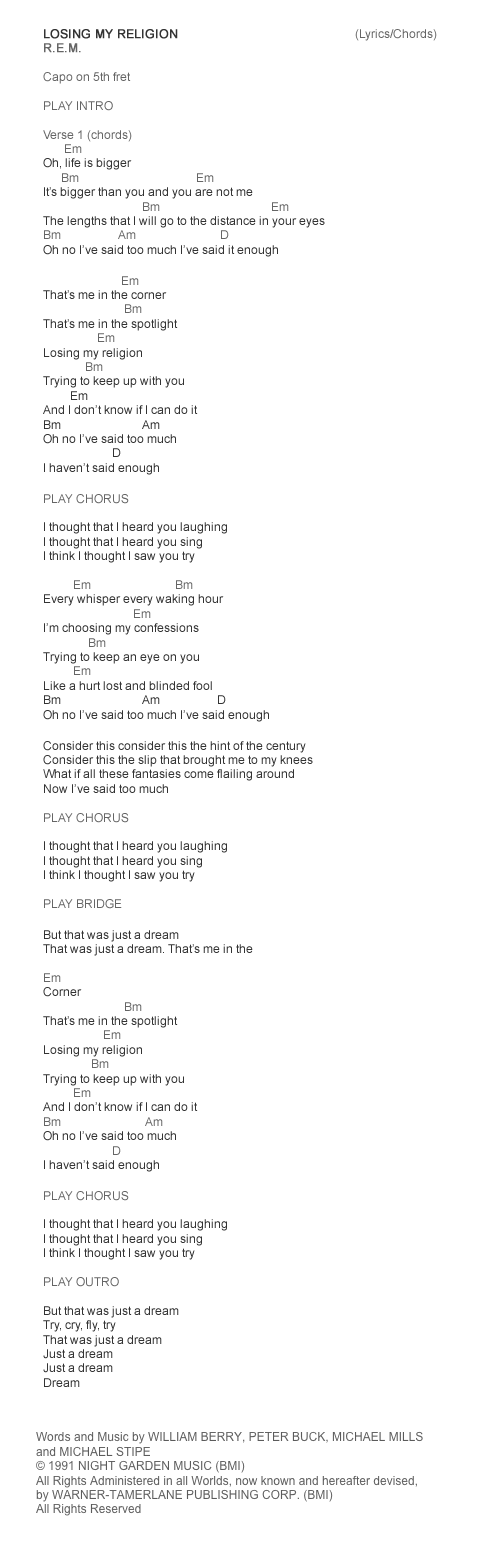
So I look again at the chords I have and do some quick thinking: will it benefit me to transpose this song so I can move it up the neck? Playing higher up the fretboard will certainly give me more of a mandolin sound to start with. The fact that Losing My Religion is in A minor is a bit of a help, as there are not many minor keys in which I feel comfortable. I decide to take a stab at E minor, which means that I’ll need to put my capo on the fifth fret. Here are our transposed chords:
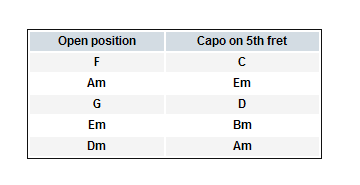
E minor turns out to have some unexpected plusses. Not only can I imitate the mandolin riff in the introduction with ease, I also discover that I can fashion the short instrumental sections (again, that also feature the mandolin on the original recording) in such a way that I can use my whole guitar instead of going with single notes. That pretty much clinches it for me. E minor it is!
One last thing before we get going: ideally, this would be a great song for two guitars, one with the capo and one without. Playing together, they will definitely cover much more of the nuances of the whole song. My decision to arrange it this way comes, in part, from knowing that this lesson is meant to be a single guitar arrangement. Therfore, I want to incorporate as many of the mandolin parts of Losing My Religion that I can into this arrangement. And, being a twelve string guitar player from day one, helps. There’s a lot of similarity between the two instruments and using a twelve-string to mimic the mandolin parts, especialy with the capo on the fifth fret, really makes a cool sounding arrangement. As always, you should feel free to play it in any manner you choose.
The Intro and Verses
As the song goes, “Let’s start at the very beginning…”
Losing My Religion kicks of on the third beat of the pick-up measure with a short riff from the mandolin. After listening to it, I’ve determined that these are the notes in the riff:
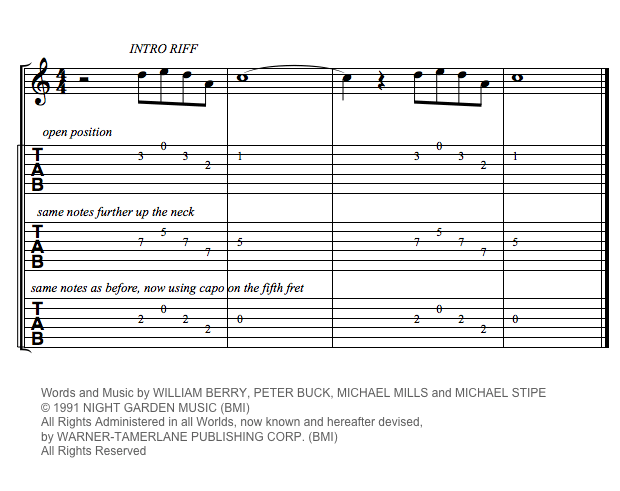
You’ll note (no pun intended) that I’ve mapped the TAB of this riff both in open position and also with the capo on the fifth fret. This is where I get my first “bonus” for playing this song with the capo. When I am playing an arrangement for one guitar, simplicity is vitally important, especially so if I am singing as well as strumming and playing a riff or two. Looking at the notes of the intro, I realize that I can finger this as an Asus2 chord (002200) and let the notes ring until I am ready to switch to the C that starts the first full measure. Let’s try the whole intro:
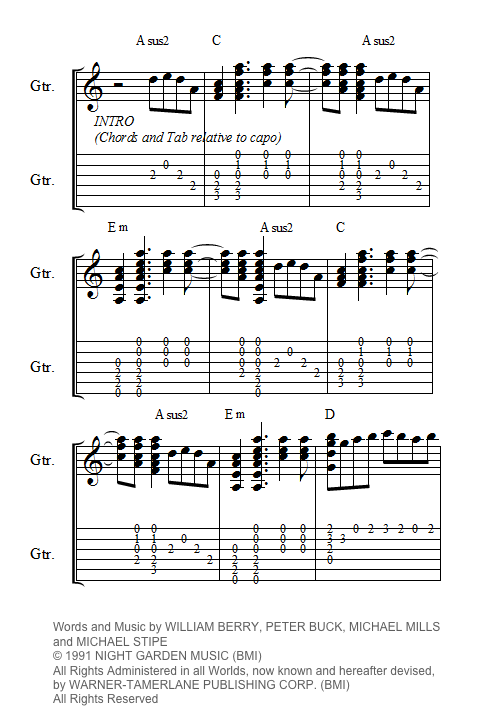
Can you see how easy this is going to be? Fret the Asus2 and let the first four notes ring out. Then switch to the C chord. You then go back to Asus2 to repeat the riff and follow that with Em. I find that anchoring my middle finger on the second fret of the D string (the E note) allows me to switch between these three chords. You’ll hear on the sound file that sometimes I’ll hit the bass note and then the chord instead simply playing the full chord. That’s just me.
Add a little flourish on the D chord that finished the intro and you’re on your way!
The verses are simply strumming the chords. You can hear my basic strumming pattern for the verses at the end of the introduction sound file, which is a lot like the strumming in the introduction. Essentially I’ve chose to play the verse strumming like this:
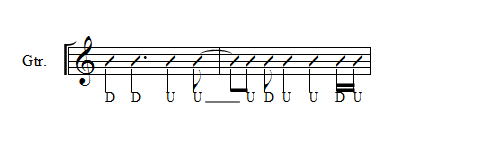
The only thing to note here is the Bm chord. Depending on your taste (and finger ability), there are numerous ways of playing this:
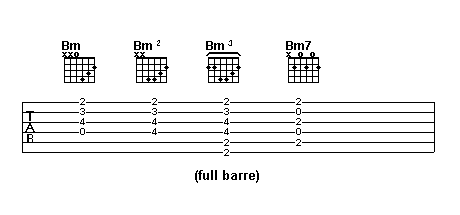
In the sample, I’m using the first voicing. To my ears, this gives me the mandolin feel I’ve been using as a guide to this arrangement. Sometimes though, I will switch to the Bm7 (the fourth voicing) in order to throw in a bass note or simply to give my fingers (and listeners) a change.
The Chorus
The chorus is the part of the song signaled by the line “I thought that I heard you laughing…”

As I get into the chorus, I bring back the mandolin riff from the intro. Essentially, it is the same as the intro – until we reach the Em chord. Here I decide that I’ve had enough of being the mandolin for a while. Now I want to be the bass. And the mandolin. I can be such a pain sometimes…
And, not to beat a dead horse or anything, once again my capo placement allows me to do this with ease. You can see that even though we are going to play an Em in the fourth measure, we don’t have to fret a single string! I hit the open sixth string hard on the downstroke and then pick the first three strings (all open!) on the upstroke. Then I walk the bass note up the scale – sixth string, second fret; sixth string third fret – alternating with my upstroke arpeggio on the open three strings.
In the last half of measure five, I have to quicken the pace of my walk. While the first three steps took two beats (four eighth notes) each, here they have to be one beat. That means throwing the arpeggio out the window and simply hitting a group of strings on the upstroke. As they say, “crude but effective.”
The Bridge and The Outro
It’s during the bridge section and again at the very end of the song that our choice of capo positioning will truly shine through. Here the mandolin takes center stage with a single note solo. But guess what? With our capo, we can play full and partial chords to totally flesh out our parts and not suddenly lose our “band” because we’re only playing one string. This is pretty important for the single-guitar performer.
We do this by use of creative chord voicing and strumming. Since the mandolin riff (on the recording) pretty much plays out over an Am chord (Em with our capo, remember), we can use the guitar’s tuning to play the melody of the riff and the rest of an Em or Em7 chord at the same time. Check it out:
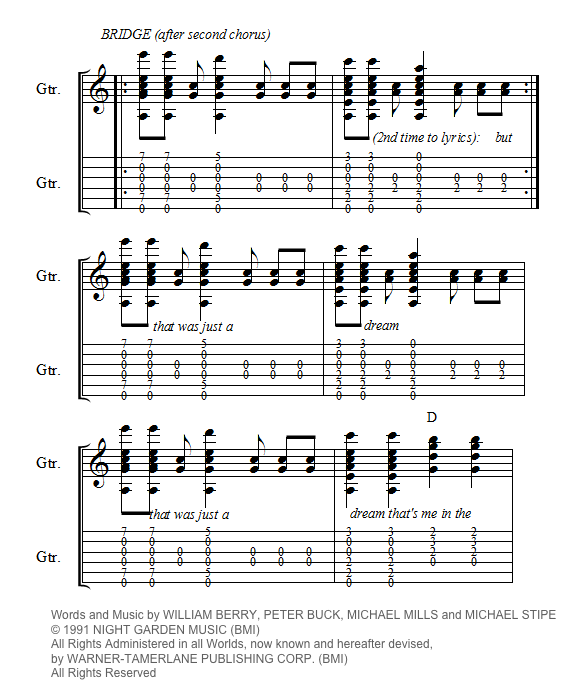
Covering the first and fifth strings at the seventh fret, we make the first two eighth notes downstroke and upstroke. We hit the middle open strings on a down once again and slide our fingers from the seventh to the fifth fret for another full downstroke. The remaining strokes in the measure are short downs. Another added bonus, we find, is that the “seventh” fret (with the capo on) turns out to be the twelfth, so we don’t have to hunt around for it!
Using the same rhythm pattern, we then switch to a regular Em chord, adding the G note (first string, third fret) for the melody and then the open E (first) string. Play this twice through for the solo and then jump in with the lyrics. I like to jump on the final Em and D, making the chords sharp and staccato, before going back to the final verse.
The outro, or coda, if you will, is almost a combination of all the other parts we’ve learned. Take a look:
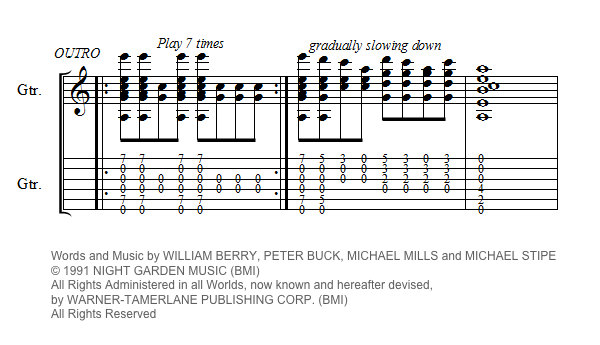
Coming out of the final chorus, we continue with the chorus progression, complete with the intro mandolin riff. Even though I didn’t do so, you can feel free to use the bass part of the chorus as well. Trust me, it will fit.
When you get done with the vocals, the first notes of the mandolin solo from the bridge reappear. We play this pattern seven times (a total of twenty-eight beats if you’re keeping count). Then we once again do the slide from the seventh fret to the fifth fret on the first and fifth strings and then, releasing the fifth string, slide on the first string from the fifth fret to the third fret and then release the first string. I do these four chords as a downstroke followed by three upstrokes.
Then, forming a D chord and using my pinky to fret the fifth fret of the first string, I again repeat the down, up, up, up pattern. With each stroke, I move my pinky – first from the fifth fret to the third, then removing it altogether and then fingering the third fret yet again.
All the while, I am gradually slowing down the tempo, making a grand finale out of the whole series of cascading, descending chords. I end with a long sweeping downstroke on an Emadd9 chord (024000), which, in case you’re interested, you won’t hear on the record. I just think it’s cool.
Okay, let’s do it. As always, remember that I am old and senile and probably don’t have all the words right! I’m sure you’re all capable of dealing with that:
A few quick notes: this is the first time we’ve tried a “live” sound file on our lessons. Yes, that’s me playing. No, it’s NOT always precisely what I’ve written out. But it will (hopefully) give you a very good idea of what you should sound like. And if there’s too much derision, we can always go back to MIDI files. Not that I get hurt feelings or anything!
I hope you enjoyed this lesson and that you have fun with this song. Those of you who play twelve string guitars should find it a lot of fun as well. And, as I mentioned earlier, Losing My Religion sounds great with multiple guitars. Teach it to one (or more!) of your friends and have a great time working out your own arrangement.
As always, please feel free to write in with any questions, comments, concerns or songs (and/or riffs and solos) you’d like to see discussed in future pieces. You can either drop off a note at the Guitar Forums or email me directly at [email protected].
Until next lesson…
Peace
True Fallacy
January 15th, 2013 @ 12:44 pm
I’ve wanted to learn how to play this for some time. THANKS!!
Lowell
September 30th, 2012 @ 11:17 pm
Outstanding!