
Guitar History
We often hear people talk about ‘getting back to the roots’ in music, so I thought I’d go ALL the way back to the roots of the guitar.
The modern guitar has a long and rich history. The very first guitar-like instrument appears on a terra cotta plaque in the Baghdad museum. The plaque is estimated to be around 3700 years old!
An instrument that sounded this good just had to be shared, and these early instruments soon spread throughout most of the known world. Egyptian paintings show similar instruments, with two or three strings and a short, fretted neck. Music was apparently “women’s work” in Egypt, as all of the existing paintings show only female musicians… but they were clearly innovators: these paintings also show the first use of plectrums, or picks.
To the north, ancient Greeks improved on the design by lengthening the neck. At this point, the instrument was called a lute, and within another 500 years or so it had spread as far East as India.
As the instrument spread outward from Mesopotamia, local variations came about – the medieval lute, the oud, the Russian balalaika, and others are all descendants of this first instrument. Not every design succeeded, of course, and some instruments like the theorbo came and went without leaving much of a mark on the musical landscape.
The immediate ancestor of the guitar is probably the gittern, a Spanish instrument dating to the late 1200s. Gitterns started out as a four-stringed instrument, but by the 1400s had expanded to seven strings – the lowest three strings were paired in octaves (as in a modern 12-string guitar), with a single E string as the highest note. These instruments were tuned just as we tune the first four strings of the modern guitar: D, G, B, and E.
Eleven string versions came next, with five paired strings and a single high E, and the pairs disappeared shortly after 1800, leaving just six strings. A few years later, the Spanish luthier Antonio Torres Jurado standardized guitar making to a fixed string length, creating the first modern classical guitar.
We don’t know a lot about the earliest musical styles performed on guitar-like instruments; most of the literate people prior to the Renaissance were members of the clergy, and frowned on non-liturgical music. Perhaps this is because some French troubadors are said to have substituted bawdy lyrics for the familiar tunes of church music in the 1200s!
The music that does survive from the early days does give us some fine examples of how music developed from monophonic melodies to the complex arrangements we hear today. Early music, with its simple harmonization, is particularly well suited for beginners, as there isn’t a lot ‘going on’ at one time.
What we think of today as full chords were pretty rare in early performance. Simple melody lines were plucked to accompany a singer, with an occasional interval of a fourth or fifth to ‘fatten up’ the melodic line.
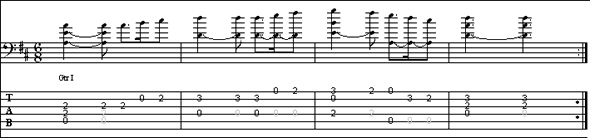
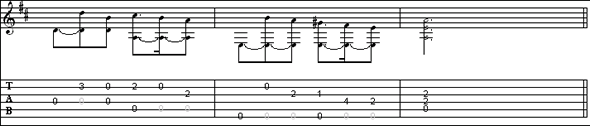
To give you a feeling for how this sounds, I’ve transcribed a short piece from the Dowland Lute manuscript, probably entitled “Jamie has lost his digger”.
This short piece is in AAB form. The only tricky fingering comes five measures from the end, with the B-F#-B; I finger this 1-4 in order to hold the B note while striking the C#.

jeffery
October 23rd, 2013 @ 1:51 pm
this is alot of help considering i am doing the same thing dude so calm down man.
john
November 7th, 2012 @ 8:34 am
This Dosent Help me at all :(
trying to do a research project on the history of the guitar.